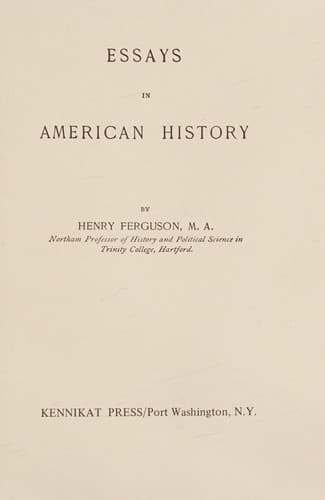
American loyalists; Andros, Edmund, Sir, 1637-1714; Society of Friends -- New England; Witchcraft -- New England
It took a long time to adjust the claims and to distribute the bounty
which was doled out by unwilling officials. It was 1783 when the war
closed, but not until 1790 was the indemnity paid out to the claimants;
and then England forced her unfortunate pensioners, made paupers by
their trust in her, to accept about £3,300,000 for losses reckoned at
over £8,000,000. It is estimated that over a thousand claimants had in
the mean time perished in want and penury. Those were on the whole more
fortunate, as events proved, who had braved it out in America than were
those who had trusted to the gratitude of England.[176]
What was the loss of America was the gain to her nearest neighbors,
the coast provinces of New Brunswick and Nova Scotia. As early as 1775
the exodus from Boston to Halifax had begun; and when Howe evacuated
the city, a large number of loyalists took refuge with the fleet and
army, and leaving all behind came to Halifax to seek their fortunes
under another sky. From that time on, throughout the war, Halifax was
the haven of refuge for persecuted loyalists.[177] At the evacuation
of New York and Savannah no fewer than 30,000 persons left the United
States for Nova Scotia. Halifax was so crowded that houses could not
be had at any price, and provisions were held at famine prices.[178]
From northern New York and Vermont the loyalists crossed over into
Upper Canada and laid the foundation of that prosperous province under
the vigorous government of Governor Simcoe, who during the war had
commanded a regiment of loyalist rangers which had done efficient
service.[179] With many a suffering, many a privation, these exiles for
conscience’ sake toiled to make homes for themselves in the wilderness,
and it is to them that the development of those provinces is due.
Familiar New England names meet one at every turn in these provinces,
especially in Nova Scotia. Dr. Inglis of Trinity Church, New York, was
the first bishop, and Judge Sewall of Massachusetts, the first chief
justice there. The harshness of the laws and the greed of the new
commonwealths thus drove into exile men who could be ill spared, and
whose absence showed itself in the lack of balance and of political
steadiness that characterized the early history of the Republic. This,
moreover, perpetuated a traditional dislike, grudge, and suspicion
between the people of the United States and their nearest neighbors,
men of the same blood and the same speech; while the new-founded
colonies, composed almost exclusively of conservatives, were naturally
slow, if sure, in their development.
Public-domain text, read in full here on John Shaqi.
Reviews
Reviews
No reviews yet
Be the first to share your thoughts on this work.
Elsewhere in the archive
Join the Discussion
Join the discussion
Sign in to leave a comment or review.
Sign InorCreate an account