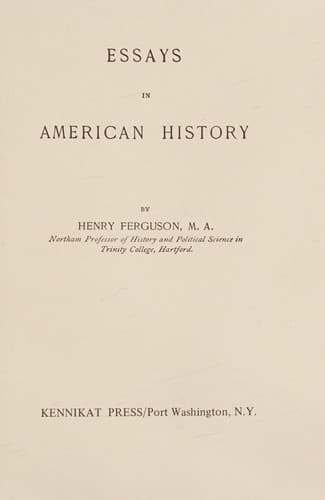
American loyalists; Andros, Edmund, Sir, 1637-1714; Society of Friends -- New England; Witchcraft -- New England
This dislike and suspicion is now fortunately diminishing with the
lapse of years, but it was a great pity it ever was created. The men
who were willing to give up home, friends, and property for an idea,
are not men to be despised or laughed at, as was the fashion of the
generation which roared with delight over the coarse buffooneries of
Trumbull’s McFingal. They are rather men for us to claim with pride,
and to honor as Americans, Americans who were true to their convictions
of duty, confessors for their political faith.
Sabine relates the following conversation:
“‘Why did you come here, when you and your associates were almost
certain to endure the sufferings and absolute want of shelter and food
which you have now narrated?’ asked an American gentleman of one of the
first settlers of St. John, New Brunswick, a man whose life ... was
without a stain. ‘Why did we come here?’ replied he, with emotion that
brought tears;--‘for our loyalty; think you that our principles were
not as dear to us as were yours to you?’”[180]
NOTES.
[152] Franklin’s _Memoirs_ (London, 1818, p. 201), (Sparks, p. 176).
“In 1754, war with France being again apprehended, a congress of
commissioners from the different colonies was by an order of the lords
of trade to be assembled in Albany; there to confer with the chiefs of
the six nations, concerning the means of defending both their country
and ours.
We met the other commissioners at Albany about the middle of June. In
our way thither I projected and drew up a plan for the union of all
the colonies under one government, so far as might be necessary for
defence, and other important general purposes. As we passed through
New York, I had there shown my project to Mr. James Alexander and
Mr. Kennedy, two gentlemen of great knowledge in public affairs, and
being fortified by their approbation, I ventured to lay it before
the congress. It then appeared that several of the commissioners had
formed plans of the same kind. A previous question was first taken,
whether a union should be established, which passed in the affirmative,
unanimously. A committee was then appointed, one member from each
colony, to consider the several plans and report. Mine happened to
be preferred, and with a few amendments was accordingly reported. By
this plan the general government was to be administered by a President
General appointed and supported by the Crown; and a grand Council to
be chosen by the representatives of the people of the several colonies
met in their respective assemblies. The debates upon it in congress
went on daily hand in hand with the Indian business. Many objections
and difficulties were started, but at length they were all overcome,
and the plan was unanimously agreed to, and copies ordered to be
transmitted to the board of trade and to the assemblies of the several
provinces. Its fate was singular: the assemblies did not adopt it, as
they all thought there was too much prerogative in it; and in England
Public-domain text, read in full here on John Shaqi.
Reviews
Reviews
No reviews yet
Be the first to share your thoughts on this work.
Elsewhere in the archive
Join the Discussion
Join the discussion
Sign in to leave a comment or review.
Sign InorCreate an account