The duties attached to family property led to the history, which is very
strange to the ideas of the present day, of Ruth’s advances to Boaz
under the advice of her mother. “It came to pass at midnight” that Boaz
“was startled (see marginal note in the Revised Version) and turned
himself, and behold a woman lay at his feet,” who had come in “softly
and uncovered his feet and laid her down.” He told her to lie still
until the early morning and then to go away. She returned home and told
her mother, who said, “Sit still, my daughter, until thou know how the
matter will fall, for the man will not rest until he have finished the
thing this day.” She was right. Boaz took legal steps to disembarrass
himself of the claims of a still nearer kinsman, “who drew off his
shoe”; so Boaz married Ruth. Nothing could be purer from the point of
view of those days, than the history of Ruth. The feelings of the modern
social world would be shocked if the same thing were to take place now
in England.
Evidence from the various customs relating to endogamy show how choice
in marriage may be dictated by religious custom. That is, by a custom
founded on a religious view of family property and family descent.
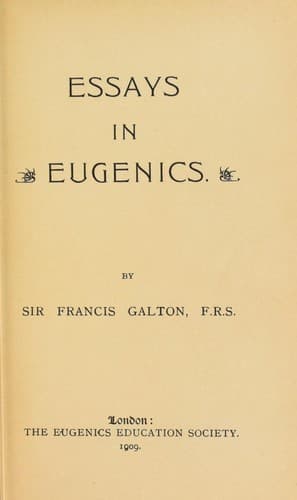
Eugenics deal with what is more valuable than money or lands, namely the
heritage of a high character, capable brains, fine physique, and vigour;
in short, with all that is most desirable for a family to possess as a
birthright. It aims at the evolution and preservation of high races of
men, and it as well deserves to be strictly enforced as a religious
duty, as the Levirate law ever was.
Public-domain text, read in full here on John Shaqi.
Reviews
Reviews
No reviews yet
Be the first to share your thoughts on this work.
Join the Discussion
Join the discussion
Sign in to leave a comment or review.
Sign InorCreate an account