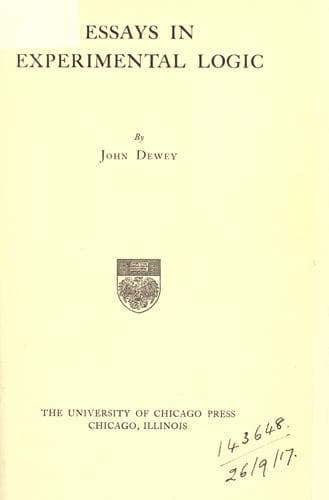
We are here face to face with a crucial point in analytic realism.
Realism argues that we have no alternative except either to regard
analysis as falsifying (à la Bergson), and thus commit ourselves to
distrust of science as an organ of knowledge, or else to admit that
something eulogistically termed Reality (especially as _Existence_,
Being as subject to space and time determinations) is but a complex
made up of fixed, mutually independent simples: viz., that Reality is
truly conceived only under the caption of whole and parts, where the
parts are independent of each other and consequently of the whole. For
instrumentalism, however, the alleged dilemma simply does not exist.
The results of abstraction and analysis are perfectly real; but they
are real, like everything else, _where_ they are real: that is to say,
in some _particular_ _co_existence in the situation where they
originate and operate.
The remark is perhaps more cryptic than enlightening. Its intent is
that reflection is an actual occurrence as much so as a thunderstorm
or a growing plant, and as an actual existence it is characterized by
specific existential traits uniquely belonging to it: the entities of
simple data as such. It is in control of the evidential function that
irreducible and independent simples or elements exist. They certainly
are found there; as we have seen they _are_ "common-sense" objects
broken up into expeditious and unambiguous signs of conclusions to be
drawn, conclusions about other things with which they--the
elements--are continuous in some respects, although discrete[4] with
respect to their sensory conditions. But there is no more reason for
supposing that they exist _elsewhere_ in the same manner than there is
for supposing that centaurs coexist along with domestic horses and
cows because they coexist with the material of folk-tales or rites, or
for supposing that pigs of iron pre-existed as pigs in the mine. There
is no falsifying in analysis _because_ the analysis is carried on
within a situation which controls it. The fallacy and falsifying is on
the part of the philosopher who ignores the contextual situation and
who transfers the properties which things have as dependable
evidential signs over to things in other modes of behavior.
Public-domain text, read in full here on John Shaqi.
Reviews
Reviews
No reviews yet
Be the first to share your thoughts on this work.
Join the Discussion
Join the discussion
Sign in to leave a comment or review.
Sign InorCreate an account