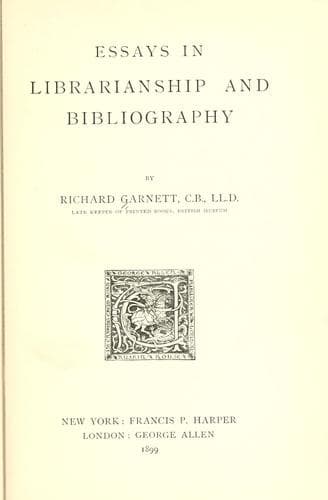
Essays in Librarianship and BibliographyGarnett, Richard
Science
Essays in Librarianship and Bibliography
Garnett, Richard
Bibliography -- Methodology; British Museum; Library science
Podianus could hardly be expected to emulate the magnanimity of Bishop
Ancina, considering that if he had often had to give scudi for his
books, he would have been reduced to the necessity of stealing them. He
was rich, however, in a thrifty wife, to whom her husband's goings-on
were an enigma and an abomination. Finding that remonstrances availed
nothing, whenever money for housekeeping was absolutely necessary, she
would lay hold of a book, and pledge it with the butcher or baker or
candlestick-maker, when Podianus would be necessitated to redeem it
somehow. He himself rarely dined and did not always sleep at home, being
sure of free quarters from other bibliophiles, who hoped that he would
one day bequeath them his library. At length he was persuaded to make a
donation of it in his lifetime, on condition that the books should
remain in his possession until his death. Either oblivious of this, or
wishing to secure other patrons, he made another prospective donation of
the books to the fathers of a certain monastery, who inscribed the
record of his benefaction upon a marble tablet, to be put up in their
chapel after his death. When this event took place, they swooped down
upon the prize, only to find a still more recent beneficiary in
possession. In their mortification they effaced the laudatory
inscription from the tablet, only leaving the initial letters D. O. M.,
which were commonly interpreted, Daturis Opes Majores—to those who
shall leave us a more substantial legacy.
Nicius mentions one more mighty book-hunter, Cardinal Peranda, of whom,
however, beyond the fact that he was enthusiastic and indefatigable in
the pursuit, we learn nothing bibliographically memorable but his
misadventure with a pet monkey, which, having got hold of the cotton
stopper of the ink-bottle (for so I must render _gossypium_ according to
my present lights) saturated with ink, must needs employ it upon the
most precious book in his whole library. An enemy of books this which
has escaped the attention of Mr. Blades. I will conclude with an
anecdote not strictly bibliographic or bibliopolic, but not unconnected
with the special objects of our Association, inasmuch as it proves the
use in Italy, early in the seventeenth century, of a minor invention
serviceable to bookmen—blotting-paper. It is the story of Muzio Oddi,
mathematician and engineer, who, though debarred from pen and ink,
solaced his imprisonment at Pesaro by the composition of mathematical
treatises, written on sheets of blotting-paper, at first by charcoal cut
to a point, afterwards, having given more stability to his paper by
pressing several sheets together, by a reed-pen dipped in ink made from
charcoal and water, and kept in a walnut shell. Sir Edward Thompson has
shown from an old record that blotting-paper was known in England in
the middle of the fifteenth century; yet sand was in more common use to
a comparatively recent date. It is a remarkable circumstance that sand
Public-domain text, read in full here on John Shaqi.
Reviews
Reviews
No reviews yet
Be the first to share your thoughts on this work.
Elsewhere in the archive
Join the Discussion
Join the discussion
Sign in to leave a comment or review.
Sign InorCreate an account