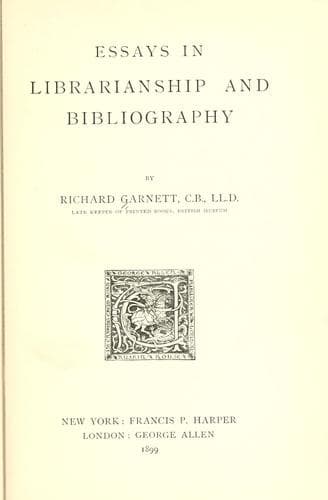
Essays in Librarianship and BibliographyGarnett, Richard
Science
Essays in Librarianship and Bibliography
Garnett, Richard
Bibliography -- Methodology; British Museum; Library science
was used instead of blotting-paper in the Reading Room of the British
Museum as late as 1838, and was then only discontinued on the
representation of Mr. Panizzi that it got into the books. If, however,
Oddi was able to procure so many sheets of it when he could not get
writing-paper, it must have been common in Italy at the period of his
imprisonment, which would probably be about 1620. I must not omit to add
that this ingenious man made the compasses he required out of twigs of
olive wood, that the books he composed under such difficulties were
actually published, and that he was eventually liberated, and died in
wealth and honour.
These few anecdotes from a restricted field of human activity may afford
some idea of the opulence of Nicius Erythræus in humorous, and at the
same time urbane gossip. He was a quaint, pleasant man, something
between Pepys and Aubrey, not of the highest intellectual powers, but a
fair judge of other men, a good scholar and Latinist, and with quite
sufficient sense to know when a story was worth repeating. He has
preserved much that would have been lost without him, and has made a
sunshine in that very shady place, the Rome of the seventeenth century.
His main defect, ornate prolixity when simple brevity would have been
more appropriate, is the besetting sin of most Jesuit prose writers. He
seems just the sort of useful, entertaining, neglected writer, whom the
presses of our Universities might advantageously reproduce, and the
illustration of his text would afford congenial employment to an
accomplished editor.
FOOTNOTES:
[161:1] Read before the Monthly Meeting of the Library Association,
London, April 1898.
LIBRARIANSHIP IN THE SEVENTEENTH CENTURY[174:1]
The natural reaction against over-statements respecting the darkness of
the dark ages, has led to the counter-statement that they were not dark
at all. We librarians know better. We know that they must have been in
darkness, inasmuch as our body did not exist to enlighten them. There
can have been no librarians where there were no libraries; and the lists
of collections of manuscripts preserved to our times sufficiently prove
that no set of men professionally interested in the custody of stores so
diminutive can have been required. The function of librarian must have
been one of the numerous offices discharged cumulatively by a single
monk, upon whom it may sometimes have been imposed by way of penance. It
was otherwise in classical antiquity. To say nothing of the Alexandrian
Library, and its connection with men as distinguished as Callimachus and
Apollonius, so late as near the close of the third century of our era
the decree of the Emperor Tacitus, that the historical works of his
illustrious namesake should be transcribed and placed in the public
libraries throughout the empire, indicates the existence of numerous
institutions of this description, under responsible officers, servants
of the State, or the municipality.
Public-domain text, read in full here on John Shaqi.
Reviews
Reviews
No reviews yet
Be the first to share your thoughts on this work.
Elsewhere in the archive
Join the Discussion
Join the discussion
Sign in to leave a comment or review.
Sign InorCreate an account