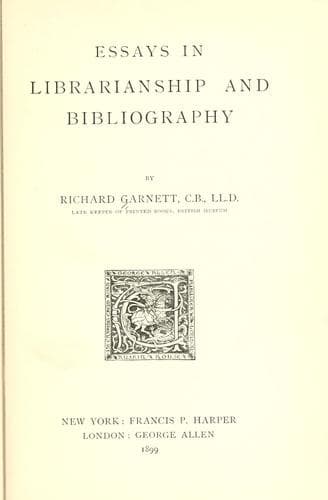
Essays in Librarianship and BibliographyGarnett, Richard
Science
Essays in Librarianship and Bibliography
Garnett, Richard
Bibliography -- Methodology; British Museum; Library science
Almost all personal trace, however, of the famous librarians of
antiquity has disappeared; but the interest attaching to the slow
emergence of their modern representatives from the flood of ignorance
and barbarism rivals that which the history of their prototypes would
excite, could this be recovered. It would be interesting to know when
and where in Renaissance, or post-Renaissance times, the accumulation of
books first became so considerable as to demand the whole time of the
officer entrusted with their custody, and thus to give birth to
librarianship as a distinct profession. Into this inquiry I do not
propose to enter. I wish merely, on the present occasion, to direct your
attention to the evidence borne about the middle of the seventeenth
century to the development at that period attained by librarianship, and
the conception of its duties and possibilities entertained by John Dury,
a man in advance of his times.
Dury was by birth a Scotchman, and by profession a divine. He had
signalised his appreciation of libraries at an early age by repairing to
Oxford with the object of studying in the Bodleian. He is entitled to
figure on the roll of librarians himself, having been appointed
deputy-keeper of the Royal Library after the execution of Charles I.,
which charge may very probably have suggested to him those thoughts on
the duties of librarians and the standard of librarianship, of which I
am to give you an account. The main object of his life, however, was the
even more important but certainly less hopeful undertaking of allaying
the acrimony of religious zealots. In pursuance of this mission we find
him almost more abroad than at home; ever labouring to appease the
dissensions of Protestants, now negotiating with Gustavus Adolphus, now
with the Synod of Transylvania; now at Utrecht, now at Brandenburgh, now
at Metz, where he submitted to the loss of his "great, square, white
beard," as a peace offering to the prejudices of French Protestantism.
He eventually, long after the Restoration, died in Hesse, where he was
entertained and protected by the Regent. It is to be feared that nothing
came of his well-meant endeavours but the witness of a good conscience
and the blessing that rests upon peace-makers. It may, perhaps, have
been inferred that he was not in all respects the most practical of men,
and this, indeed, appears from his works on education rather than from
his suggestions on libraries. But his utopianism was less owing to
infirmity of judgment than to the habitual elevation of his moral and
intellectual standard. He thought better of his fellow-men than they
deserved, and was himself a man of eminent desert. If his own writings
did not survive to speak for him, it would be sufficient to record that
he was the intimate friend of Samuel Hartlib, the foreign guest to whom
England is so greatly indebted as philanthropist and practical
agriculturist, and to whom several of his own treatises are inscribed.
Public-domain text, read in full here on John Shaqi.
Reviews
Reviews
No reviews yet
Be the first to share your thoughts on this work.
Elsewhere in the archive
Join the Discussion
Join the discussion
Sign in to leave a comment or review.
Sign InorCreate an account