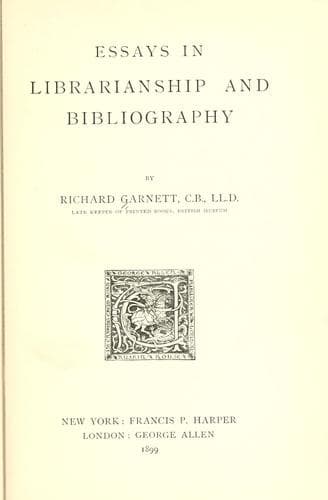
Essays in Librarianship and BibliographyGarnett, Richard
Science
Essays in Librarianship and Bibliography
Garnett, Richard
Bibliography -- Methodology; British Museum; Library science
"And so," he continues, "accordingly sought after and valued in that
regard and not in regard of the service which is to be done by them unto
the Commonwealth of Israel. For the most part men look after the
maintenance and livelihood settled upon their places more than upon the
end and usefulness of their employments. They seek themselves and not
the public therein, and so they subordinate all the advantages of their
places to purchase mainly two things thereby, viz., an easy subsistence
and some credit in comparison of others, nor is the last much regarded
if the first may be had. To speak in particular of library keepers in
most universities that I know, nay, indeed, in all, their places are but
mercenary, and their employment of little or no use further than to look
to the books committed to their custody, that they may not be lost or
embezzled by those that use them, and this is all."
Dury has, no doubt, here put his finger upon the main cause of the low
condition of the librarianship of his day. The general conception of the
librarian's functions was far too narrow. He was allowed no share in the
government of his own library. He had not necessarily anything to do
with the selection of new books, nor was it expected of him that he
should advise and direct the studies of those resorting to the
collections committed to his care. In fact he was not usually qualified
for such activity, or even for the minor task of making these
collections serviceable by means of catalogues and indexes. The
development of literature had advanced so far as to necessitate the
library custodian, but had not yet produced the library
administrator—the Denis and Audiffredi of the succeeding century. Dury
saw this, and also saw that the ideal librarian he had conceived in his
own mind would need better pay that he might do better work. One
exception to his apparently sweeping statements must be noted. Bodley's
librarians in the seventeenth century were undoubtedly men of high
literary distinction. Yet even here the arrangements for the librarian's
remuneration were unsatisfactory, and wrong in principle.
"I have been informed," says Dury, "that in Oxford the settled
maintenance of the library keeper is not above fifty or sixty pounds per
annum, but that it is accidentally _viis et modis_, sometimes worth a
hundred pound. What the accidents are, and the ways and means by which
they come, I have not been curious to search after."
So we are not to know by what shifts Mr. Nicholson's seventeenth-century
predecessor mended his salary. "Hay and oats," says Dean Swift, "in the
hands of a skilful groom will make excellent wine, as well as ale, but
_this_ I only _hint_."
Dury now proceeds to develop his ideas in a fine and wise passage:—
Public-domain text, read in full here on John Shaqi.
Reviews
Reviews
No reviews yet
Be the first to share your thoughts on this work.
Elsewhere in the archive
Join the Discussion
Join the discussion
Sign in to leave a comment or review.
Sign InorCreate an account