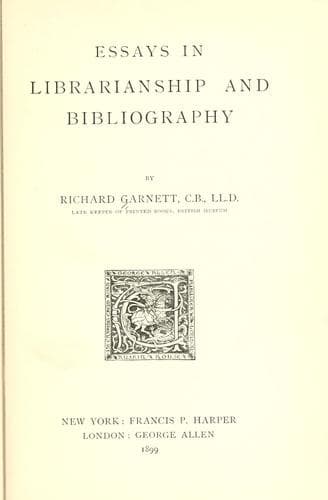
Essays in Librarianship and BibliographyGarnett, Richard
Science
Essays in Librarianship and Bibliography
Garnett, Richard
Bibliography -- Methodology; British Museum; Library science
This established, Dury proceeds to point out how the library should be
made useful. His main idea is that a library should be a kind of
factory, and it is astonishing how often he contrives to introduce the
word "trade" into his proposals. Underlying this peculiar phraseology is
the thought that so long as the library only exists for the advantage of
those who may choose to resort to it, it is like a talent buried in a
napkin; that to be really useful it must go to the public, and that the
librarian must place himself in active communication with men of
learning. It was hardly conceived in Dury's day that any but scholars
could have occasion for libraries, but translating his proposals into
the language of our time, it will appear that they contemplate such an
ideal of librarianship as is professed in America, and is realised with
no small success in many of our leading free libraries. The first
condition is a good catalogue:—
"That is," says Dury, "all the books and manuscripts according to the
titles whereunto they belong, are to be ranked in an order most easy and
obvious to be found, which I think is that of sciences and languages,
when first all the books are divided into their _subjectam materiam_
whereof they treat, and then every kind of matter subdivided into their
several languages."
Evidently Dury was little troubled with the questions which have so
exercised librarians since his time. "The subject-matter of which a book
treats" is not always easy to ascertain. It might have puzzled Dury
himself to decide whether his own tract should be catalogued along with
books on libraries, or with the "Reformed School" to which it is
professedly an appendix, and to which half its contents have a direct
relation. The suggestion that books should be catalogued by languages
was propounded before the British Museum Commission of 1849, and
promptly dismissed as the fancy of an amateur. It would be curious to
see Pope's Homer in one catalogue, Voss's in another, and the original
in a third.
Public-domain text, read in full here on John Shaqi.
Reviews
Reviews
No reviews yet
Be the first to share your thoughts on this work.
Elsewhere in the archive
Join the Discussion
Join the discussion
Sign in to leave a comment or review.
Sign InorCreate an account