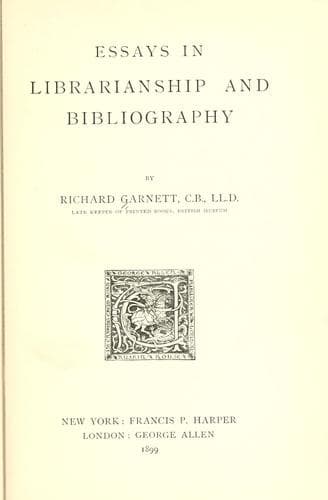
Essays in Librarianship and BibliographyGarnett, Richard
Science
Essays in Librarianship and Bibliography
Garnett, Richard
Bibliography -- Methodology; British Museum; Library science
Other interesting questions respecting the early printers remain which
we should much like to have answered. Did they try to keep their art and
mystery secret? Were they their own type-founders? Were their types cast
near the scene of their labours, or transported from great distances?
How did they set about obtaining the favour of the great men who
patronised them? Was their discovery universally welcomed by the
learned? or did some consider that books were low, and manuscripts alone
worthy the attention of a self-respecting collector? Were they stunned
by the objurgations of angry copyists? or endangered by any supposed
connection with the black art? Were they in general their own editors
and proof-correctors? and what were their relations with the scholars
who aided them with annotations, or wrote dedications for their books?
At a considerably later period we obtain most satisfactory insight into
the economy of a great printing establishment from the memoirs of the
house of Plantin, at Antwerp. For these early times, except for such
information as may be derived from the accidental discovery of contracts
and similar documents, we must depend upon hints gleaned from the books
themselves, which are usually found in their colophons.
Neither my time nor yours would admit of my entering into the matter
very deeply at present, but I have selected a few instances, entirely
from books printed at Rome and Venice, which may serve to indicate what
illumination colophons may occasionally contribute to the obscurity of
early typography, and sometimes to that of the manners and ideas of the
times. And here I may remark incidentally, that the history of early
printing is highly creditable to the age which fostered the art, and to
those who exercised it, without, one may almost say, producing a single
frivolous book for fifty years. An account of it mainly from the point
of view of its contact with human life—the books which the early
printers thought worth reproducing, the success of these, as attested by
the comparative frequency of their republication, the proportion in
which studies and professions, arts and trades, respectively benefited
by the new discovery, would make a fascinating story in the hands of a
writer of insight and sympathy. We have materials enough; it is now
required to make the dry bones live.
Public-domain text, read in full here on John Shaqi.
Reviews
Reviews
No reviews yet
Be the first to share your thoughts on this work.
Elsewhere in the archive
Join the Discussion
Join the discussion
Sign in to leave a comment or review.
Sign InorCreate an account