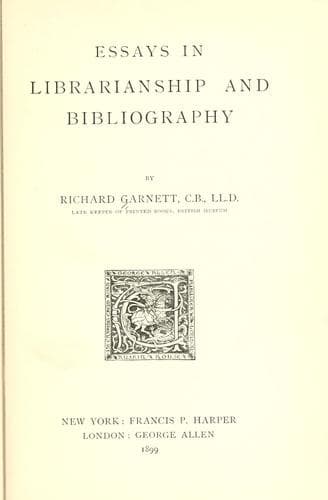
Essays in Librarianship and BibliographyGarnett, Richard
Science
Essays in Librarianship and Bibliography
Garnett, Richard
Bibliography -- Methodology; British Museum; Library science
In a colophon it will naturally be expected that among the sentiments
more frequently finding expression, should be the printer's joy in his
art, and assertion of its claims to admiration. Udalricus Gallus, of
Rome, boasts that he can print more matter in a day than a copyist can
transcribe in a year: "Imprimit ille die quantum non scribitur anno."
The same printer tells the geese that saved the Capitol that they may
keep their quills for the future, as the cock (_Gallus_) has cut them
out. Joannes de Spira, the first printer established at Venice, declares
that his first attempt has so far surpassed the work of the scribes that
the reader need set no bounds to his anticipations; just as an electric
light company might advertise "Gas entirely superseded." He celebrates
his type as more legible than manuscript:
"Namque vir ingenio mirandus et arte Joannes
Exscribi docuit clarius ære libros."
Now the word _docuit_ (_taught_) is not really appropriate to one who
merely exercised an art he had learned from others. The question might
be raised whether the reference is not to the inventor of printing,
Joannes Gutenberg, and whether in this book of 1469 we have not the
earliest testimony to his invention of printing. If so, this is indeed a
precious colophon; but I suppose it must be admitted to be more likely
that Spira was thinking of himself, or that his poet was not
over-discriminating in his praise of his employer. The point, however,
is worth considering. Spira's brother, Vindelinus, enunciates the
excellent maxim that the renown of a printer is rather to be estimated
by the beauty than by the number of his productions:
"Nec vero tantum quia multa volumina, quantum
Qui perpulchra simul optimaque exhibeat."
Nothing, indeed, is more characteristic of the early printers than the
stress they laid upon accuracy. From another colophon we learn that an
edition of Sallust at that early period consisted of five hundred
copies. In another the same printer declares that he will deign to sell
nothing that is not perfectly correct. In another he talks of having
carefully expurgated his author, as if he had been printing Juvenal or
Martial, but as the author is a divine the remark can only refer to the
correctness of the text. John of Cologne goes further still, and asserts
that his book is absolutely immaculate:
"Emptor, habes careant omni qui crimine libri,
Quos securus emas, procul et quibus exulat error."
Public-domain text, read in full here on John Shaqi.
Reviews
Reviews
No reviews yet
Be the first to share your thoughts on this work.
Elsewhere in the archive
Join the Discussion
Join the discussion
Sign in to leave a comment or review.
Sign InorCreate an account