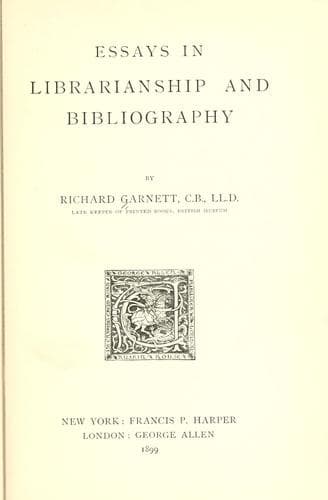
Essays in Librarianship and BibliographyGarnett, Richard
Science
Essays in Librarianship and Bibliography
Garnett, Richard
Bibliography -- Methodology; British Museum; Library science
Occasionally the corrector's name is mentioned. A remarkable instance of
this is where Vindelinus de Spira prints an Italian book, the "Divine
Comedy," the language of which he probably would not understand, when
Christoval Berardi, of Pesaro, is especially named as the corrector in
an Italian sonnet probably composed by himself. In an instance of an
arithmetical work the printer, Erhard Ratdolt, distinctly claims the
merit of the correctness of the press as his personal merit, and we
learn from other sources that he was a good mathematician.
Another class of colophon sets forth the deserts of the author instead
of those of the printer, and it is noteworthy that these, when in verse,
are generally expressed in a more elegant style. It is to be regretted
that the verses written for Sweynheym and Pannartz, the fathers of the
art in Italy, were generally so bad; yet there is something to be
learned from them. We discover that they thought it necessary to
apologise for their uncouth German names (_Aspera ridebis Teutonica
nomina forsan_); and that a Roman patrician named Maximus—a man to be
ever honoured for his public spirit—had given them and their press
house-room in his palace. We learn from other colophons that an edition
of Sallust consisting of four hundred copies, and that two editions of
Cicero's Epistles to his friends, were carried through the press in four
months. The comparative cheapness of typography is also a frequent
matter of congratulation. It is said to have brought Virgil within the
reach of all scholars, and to have enabled every man to be his own
lawyer; but the printer seldom tells us what the price of the volume
was. We observe that the trade of the book-producer has not yet become
differentiated into the two great classes of printers and publishers.
While, as before remarked, there is every reason to conclude that the
early printers were persons of liberal education, we do not, so far as I
am aware, find evidence of this mechanical craft being exercised by men
of gentle blood. I have, however, already mentioned the priestly
printer, Clemente Patavino, and a colophon reveals that the printers of
one book were two priests. One rather wonders what became meanwhile of
their religious duties. I suppose that a priest would not in general
have been allowed to follow a secular calling, at least openly, but in
this instance of printing there is no attempt at concealment. A
circumstance honourable in its way to the craft to which we owe our
existence, and suggesting that the ecclesiastical authorities of the
fifteenth century thought of printers as our friend Mr. Dewey rightly
tells we ought to think of librarians.
Public-domain text, read in full here on John Shaqi.
Reviews
Reviews
No reviews yet
Be the first to share your thoughts on this work.
Elsewhere in the archive
Join the Discussion
Join the discussion
Sign in to leave a comment or review.
Sign InorCreate an account