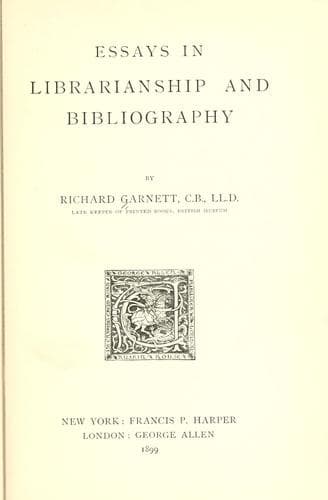
Essays in Librarianship and BibliographyGarnett, Richard
Science
Essays in Librarianship and Bibliography
Garnett, Richard
Bibliography -- Methodology; British Museum; Library science
It is further to be borne in mind that the classification now to be
described does not in absolute strictness apply to the entire library,
but to the acquisitions—comprising, however, nearly four-fifths of the
whole—made since Sir Anthony Panizzi's accession to office as keeper of
the printed books. The books in Montague House were indeed
scientifically arranged on their removal to the new premises, but space
was then wanting to carry out the views entertained by the officer
principally entrusted with their arrangement—the late Mr. Thomas Watts,
a gentleman of prodigious memory and encyclopædic learning. Mr. Watts
subsequently obtained space more in correspondence with the
comprehensiveness of his ideas, and the Museum library will bear the
impress of his mind for all ages. With his name will be associated that
of the late keeper, Mr. Rye, for many years his coadjutor, and whose own
independent arrangement of the Grenville library and the
reference-library of the reading-room will always be cited as models for
the disposition of limited collections. I trust to be excused this brief
reference to gentlemen prematurely lost to our profession—the former by
death, the latter by indisposition, brought on, it is to be feared, by
over-application to his official duties. To the example of the former
and the instruction of the latter I am indebted for whatever claim I may
have to address you on a subject to which I can contribute little of my
own.
The classification of a great library is equivalent to a classification
of human knowledge, and may, if men please, become the standard or
symbol of conflicting schools of thought. It might, for example, be
plausibly maintained that knowledge, and therefore the library, should
begin with the definition of man's relation to the unseen powers around
him—that is, with Natural Theology. Or with man himself as the unit of
all things human—that is, with Anthropology. Or, on Nature's own
pattern, with the most rudimentary forms of existence. Hence, as we
heard yesterday from the distinguished gentleman who here represents the
fifth part of the world, the reading-room library at Melbourne begins
with works on the subject of Sponges. Fortunately for the neutral
bibliographer, there exists a book which not only holds in civilised
countries a place unique among books, but which has further established
its claim to precedence by the practical test of being the first to get
itself printed. The Museum classification accordingly begins with the
Bible, and I venture to express the opinion that every sound
classification will do the same.
Public-domain text, read in full here on John Shaqi.
Reviews
Reviews
No reviews yet
Be the first to share your thoughts on this work.
Elsewhere in the archive
Join the Discussion
Join the discussion
Sign in to leave a comment or review.
Sign InorCreate an account