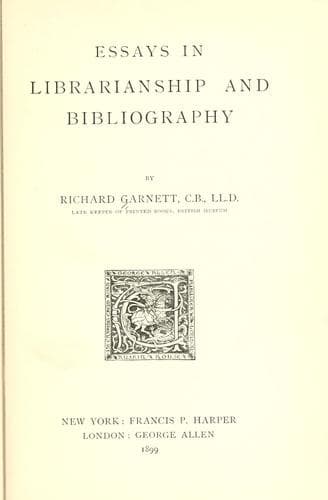
Essays in Librarianship and BibliographyGarnett, Richard
Science
Essays in Librarianship and Bibliography
Garnett, Richard
Bibliography -- Methodology; British Museum; Library science
When the next question emerges, how to arrange the Bible itself, we
alight at once upon a few simple principles, which, with the necessary
modifications, will prove applicable throughout. It is obvious that
entire Bibles should precede parts of Bibles; that originals should
precede translations; the more ancient originals, the more recent; and
Bibles in both the original tongues those in one only. We thus obtain
the following arrangement at starting: Polyglots, Hebrew Bibles, Greek
Bibles. It is equally apparent that Greek cannot be fitly succeeded by
any tongue but Latin; that Latin is most naturally followed by its
modern derivatives; that these draw after them the other European
languages in due order; the Slavonic forming a link with the Oriental,
which in their turn usher in the African, American, and Polynesian.
Concordances, consisting of the words of the Bible detached from their
context, form a convenient link with Commentaries. The latter fall into
two principal sections, according as they relate to Scripture in its
entirety or to some particular part. In arranging the former, the
erudite labours of scholars are, as far as possible, kept apart from the
popular illustrative literature of modern days. The order of
commentaries on separate books must, of course, correspond with that of
the books themselves in the canon of the Bible.
Next succeeds the very important class of literature representing the
Bible in contact with society through the medium of the Church. The most
obvious form of this relation is the liturgical. Liturgies accordingly
succeed Scripture in the Museum arrangement, precedence being given to
the various Churches in the order of their antiquity. A minor but very
extensive class of Liturgy, the Psalm and Hymn, naturally follows as an
appendix, preceding Private and Family Devotion, which prefaces works on
liturgical subjects in general. The next great department of this class
of literature ensues in the shape of Creeds and Catechisms. These pass
into formal expositions of dogmatic theology, including theological
libraries; which lead to the collected works of divines, commencing with
the Fathers. The same order is observed here as in the arrangement of
the Bible in its various languages: the Greek Fathers leading to the
Latin, the Latin to the divines of the nations speaking languages
derived from the Latin, and these to the Teutonic nations, a division
practically equivalent to one into Catholic and Protestant. The general
theological literature of each nation follows in the same order,
excluding works treating of special theological questions, but including
all the immense mass of printed material relating to the Reformation and
the controversies resulting from it down to the present day. With these
the subject of General Theology may be deemed concluded, and we enter
not only upon a fresh department, but upon a fresh numeration. The
book-presses embracing the subjects hitherto described all bear numbers
Public-domain text, read in full here on John Shaqi.
Reviews
Reviews
No reviews yet
Be the first to share your thoughts on this work.
Elsewhere in the archive
Join the Discussion
Join the discussion
Sign in to leave a comment or review.
Sign InorCreate an account