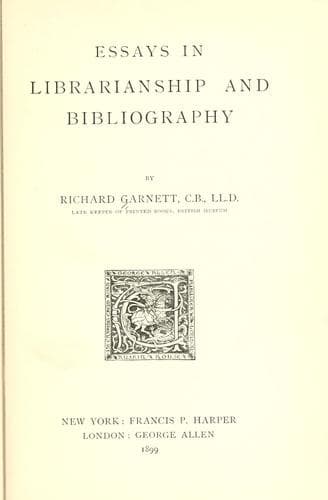
Essays in Librarianship and BibliographyGarnett, Richard
Science
Essays in Librarianship and Bibliography
Garnett, Richard
Bibliography -- Methodology; British Museum; Library science
Such is, in its main features, the system of book-press arrangement
which I have undertaken to describe. I have no fear but that it will be
pronounced in essentials logical and philosophical. It has undoubtedly
proved eminently convenient in practice. That it should be open to
revision on some points is inevitable from the nature of things, and
from two circumstances more especially—its gradual development as
subject after subject was added to the library, and the degree in which
it represents the idiosyncrasy of a single mind. Some minor oversights
must be admitted. Geology, for example, should unquestionably have
preceded Botany. I venture more extensive criticisms with hesitation,
yet I cannot help remarking that I perceive no valid reason for the
severance of so manifest a branch of History as Biography from the
parent stem by the intrusion of the entire department of Geography;
while it appears to me that the Useful Arts would have formed, through
Domestic Economy, a more natural sequel to Medicine than Fine Art, and
in arranging the latter department I should have assigned the last
instead of the first place to Archæology and its allied subjects.
Forensic Medicine might also have been conveniently placed at the _end_
of Law, to connect that subject with Natural Science. I should further
feel much inclined to form a class for Encyclopædias immediately after
Philology; both because dictionaries of general knowledge seem
legitimate successors to dictionaries of languages, and that the end of
the classification might be answerable in dignity to the beginning. I am
aware how much room for diversity of opinion may exist on these and
similar points. On a more serious defect there can be no difference of
opinion, but it is a defect inherent in all finite things. In an ideal
classification by book-press one separate press, at least, would be
provided for each subject, however minute. But an ideal library would
also have room for each subdivision. We cannot have the ideal
classification without the ideal library, and, although I hazard nothing
in saying that, thanks to the genius of the designer, Sir Anthony
Panizzi, economy of space in the new buildings of the Museum has been
carried to the utmost extent conceivable, space is still insufficient to
provide a distinct niche for every well-marked division of a subject.
Upwards of five hundred such subdivisions are provided for; nevertheless
this large number is not exhaustive. Without such an exhaustive
distribution, the actual classification on the shelves, which is all I
have undertaken to describe here, can never be conterminous with the
ideal classification of the study. If, however, the Museum library has
been unable to achieve an infinity of space, it has secured a
practically indefinite numerical expansiveness by the elastic system
referred to in our President's address, in further illustration of which
I may be allowed a few words. On the removal of the books from Montague
Public-domain text, read in full here on John Shaqi.
Reviews
Reviews
No reviews yet
Be the first to share your thoughts on this work.
Elsewhere in the archive
Join the Discussion
Join the discussion
Sign in to leave a comment or review.
Sign InorCreate an account