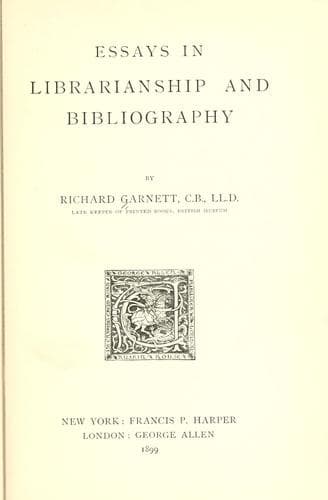
Essays in Librarianship and BibliographyGarnett, Richard
Science
Essays in Librarianship and Bibliography
Garnett, Richard
Bibliography -- Methodology; British Museum; Library science
The extensive and miscellaneous division which succeeds may, perhaps,
best be defined under the head of Philosophy, alike in its scientific
principles and in its application to human life. Commencing with
Political Philosophy, or the Science of Government, it runs rapidly
through the politics of the various nations, in the geographical order
previously detailed, passes into Political Economy, with the allied
subjects of Finance, Commerce, and Social Science; thence into
Education, and, by the minor morals so intimately allied with the latter
subject, into Ethics, including works on the condition of Woman, Peace,
Temperance, and similar topics. Speculative Philosophy succeeds,
introducing Mathematics, on which hangs the great department of Applied
Mathematics, including all physical sciences except the biological. The
various branches are carefully discriminated, and room is found among
them for the so-called Occult Sciences, and for Military and Naval
matters, the series appropriately concluding with Chemistry, or the
science which aims at the resolution of all matter into its original
elements. The remaining sections, though most important and extensive,
are very simple in arrangement, and may be dismissed very briefly. They
are: History; Geography, with Voyages and Topography; Biography; Poetry
and the Drama; Belles Lettres, including Fiction; and Philology. The
arrangement is invariably the same: collected works on each subject
being placed first, and a geographical order being adopted for the rest
when the conditions of the case allow. Genealogy is regarded as an
appendix to History; Letters to Biography; Elocution, with Literary
Criticism and Bibliography, to Poetry and the Dramatic Art. The class of
Belles Lettres is headed by Libraries and Cyclopædias.
It should be stated that the system here explained refers in the
strictest sense only to works complete in themselves, and not to
Periodicals, Academical Publications, and State Papers, which are placed
separately. Although, however, these constitute distinct series, the
principle of classification is practically identical. The same remarks
apply to the Oriental departments of the collection, the Grenville
library, and the reference-library of the reading-room.
Public-domain text, read in full here on John Shaqi.
Reviews
Reviews
No reviews yet
Be the first to share your thoughts on this work.
Elsewhere in the archive
Join the Discussion
Join the discussion
Sign in to leave a comment or review.
Sign InorCreate an account