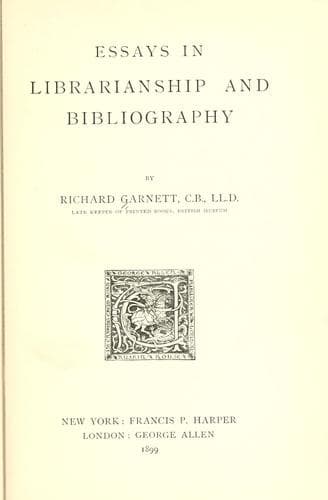
Essays in Librarianship and BibliographyGarnett, Richard
Science
Essays in Librarianship and Bibliography
Garnett, Richard
Bibliography -- Methodology; British Museum; Library science
elements of cost had been suppressed. On the other hand, the _bona
fides_ of customers must be guaranteed; and the Treasury will scarcely
help unless the obligation to recoup it as far as possible is
acknowledged and acted upon. The best principle, I apprehend, would be
to proportion charges as nearly as possible to the expenditure of
material—a variable quantity, depending upon the amount of work
done—and to look upon the salaries of the photographic officer and his
assistants as expenses to be covered as far as possible—but with which
the State is not bound to concern itself more than with the salaries of
other literary and artistic servants from whom it does not expect
pecuniary returns.
Ere I quit the subject, suffer me to advert to one aspect of it of
national and even international concern. I allude to the service which
photography can render in the preservation and dissemination of the
national records. The Record Office, in London at least, is no doubt as
nearly fireproof as a building can be made; its guardians must say
whether it is so absolutely impregnable as to supersede all need for the
precaution of making a duplicate copy of any of its treasures. But I
know that it has unique documents relating to the most interesting
events in Scotch history, facsimiles of which would be acceptable
throughout Scotland. I imagine that these are but types of a large class
of documents; and I am sure that the sight of papers relating to
memorable transactions, or bearing the signatures of memorable men,
would foster historical study and patriotic feeling throughout the
length and breadth of the land. But there is another class of records,
for whose safety and accessibility measures should undoubtedly be taken.
I refer to the parish registers. This is no new idea; it has been
frequently proposed that such documents should be removed to London and
collected in a great central repository. To this, as regards the
originals, I cannot assent, both from respect for the rights of property
and from the fear lest some unlucky day the registers of the entire
kingdom might disappear in one common catastrophe. Photography would
solve the problem. With regard to the international aspect of the
question, it may be fairly expected that if we lead, other nations will
follow, and that we shall have to follow if we let them lead. Suppose
that France and we have taken the step in concert, we shall be in a
position to mutually exchange copies of all the important documents
illustrative of the history of either nation contained in the archives
of both. Suppose Italy and Spain to join, and we may have the chief
materials of English history at home, and shall no longer be obliged to
despatch agents to calendar Venetian state papers, or unriddle the
ciphered scrolls of Simancas. The conception is so fruitful, its
application is so manifold and momentous, that I half recoil, like Fear,
afraid of the picture myself have painted. Yet I believe there is
Public-domain text, read in full here on John Shaqi.
Reviews
Reviews
No reviews yet
Be the first to share your thoughts on this work.
Elsewhere in the archive
Join the Discussion
Join the discussion
Sign in to leave a comment or review.
Sign InorCreate an account