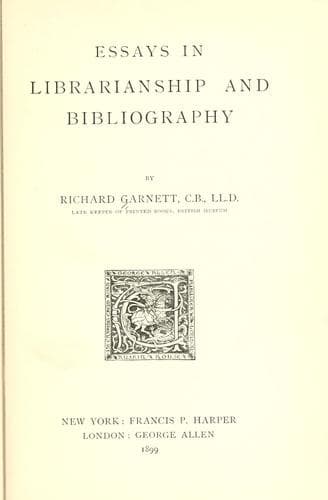
Essays in Librarianship and BibliographyGarnett, Richard
Science
Essays in Librarianship and Bibliography
Garnett, Richard
Bibliography -- Methodology; British Museum; Library science
nothing in it that upon sober examination will not be found to follow
naturally from the simple propositions with which I began, that the
photographic reproduction of national property should be the concern of
the nation; and that to a great museum or library photography should be,
not a tool, but a limb.
FOOTNOTES:
[234:1] Read before the Library Association, Dublin, September 30, 1884.
THE TELEGRAPH IN THE LIBRARY
Library administration, like all other departments of human activity in
this age, must experience the results of the unexampled development of
science in its application to the affairs of life. The most immediately
obvious of these are the mechanical: so simple a device as the
sliding-press, as will be shown in its place, has saved the nation
thousands of pounds. The most promising field for such achievements has
hitherto been the United States of America, where the application of
scientific contrivances to ordinary purposes is more general than in
Europe, and where the more important libraries are new structures, where
improvements can form part of the original plan, with no fear of
impediment from arrangements already existing. Next to mechanics,
photography and electricity may be named as the scientific agencies
chiefly adapted for the promotion of library service. Photography has
been sufficiently treated in another essay in this volume. The services
of electricity will be most cordially acknowledged by those who best
remember the paralysis of literary work, alike official and private,
engendered by a fog at the British Museum, and in particular recall the
appearance of the Reading Room, a Byzantine "tower of darkness," with a
lantern dimly burning in the centre, the windows presenting the
appearance of slate, and dubious figures gliding or stumbling through
the gloom—attendants brought in from the library to take care that the
handful of discontented readers did not profit by the opportunity to
steal the books. All this nuisance has been abolished by the electric
light, which not only renders the Reading Room available for the public
on dark days, but allows the ordinary work of the Museum to be carried
on in all departments; the same may be said of all other libraries. The
beautiful, potent, and above all safe electric ray is an advantage to
all, and in dark days a passage from death unto life for those libraries
where, as in the Museum, gas has been proscribed on account of its
danger and its injurious effects upon books.
Public-domain text, read in full here on John Shaqi.
Reviews
Reviews
No reviews yet
Be the first to share your thoughts on this work.
Elsewhere in the archive
Join the Discussion
Join the discussion
Sign in to leave a comment or review.
Sign InorCreate an account