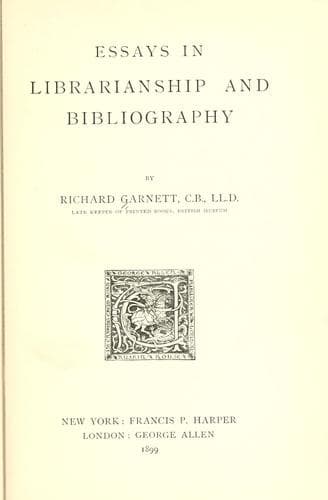
Essays in Librarianship and BibliographyGarnett, Richard
Science
Essays in Librarianship and Bibliography
Garnett, Richard
Bibliography -- Methodology; British Museum; Library science
The question whether I am right in laying so much stress on the timely
provision of space in libraries depends, as I have intimated, upon the
more serious question, whether the library movement is to prove a
success. If it is not, we need not trouble ourselves. If the present
free libraries—at least those in populous towns and centres of
intellect and industry—are not to be the nuclei of much more important
institutions than they are at present; if they are not to become the
pride of their respective districts, and to be supported by them upon a
much more liberal scale than is now the case; if they are not to expect
liberal accessions from the generosity of private donors; if they are
not to be affiliated with whatever agencies exist around them for the
promotion of culture; if, shedding from time to time what they may deem
their obsolete books, they are to renounce all claim to an historical
character, and only provide for those needs for which the circulating
library exists already; then, indeed, the question of space need not
concern us. But if the reverse of all this is to be the case; if they
are to become noble libraries, store-houses of local and municipal as
well as merely utilitarian literature; if all descriptions of English
literature are to be at least fairly represented; if private collectors
are to be made to see that the local library would afford a worthy
repository for their books; then the question of space cannot be too
attentively considered, or, in the height of success, the library may
break down. You know the value of land in large towns, and the
costliness of extending any premises that may be situated in a good
quarter, and surrounded by shops, or warehouses, or public buildings.
The possibilities of future extension should never be lost sight of when
a site for a library is selected. But, as the most desirable site cannot
always be had, it is still more important so to plan the library from
the first that it may be susceptible of inner development, without
trenching upon the adjoining land; and where, in the case of existing
libraries, this precaution has been neglected, to lose no time in
adapting the library for interior extension, if possible. At the Museum
we have at present two methods—the sliding-press, whether suspended or
resting on the ground, and the pivot-press. Both these have been
described to you. But they by no means exhaust the possibilities of
economising space, and I wish to draw your attention to other ingenious
methods, which, however, I am not about to describe, for I take this to
be the proper business of the inventor. That they must be worth
attention you will all agree, when I tell you they are devised by Mr.
Virgo. Mr. Virgo, as his name seems to imply, is a gentleman of singular
modesty. I do not think that, but for me, he would ever have received
the credit due to him for his share in the invention of the
sliding-press; nor do I think that he has done nearly enough to bring
Public-domain text, read in full here on John Shaqi.
Reviews
Reviews
No reviews yet
Be the first to share your thoughts on this work.
Elsewhere in the archive
Join the Discussion
Join the discussion
Sign in to leave a comment or review.
Sign InorCreate an account