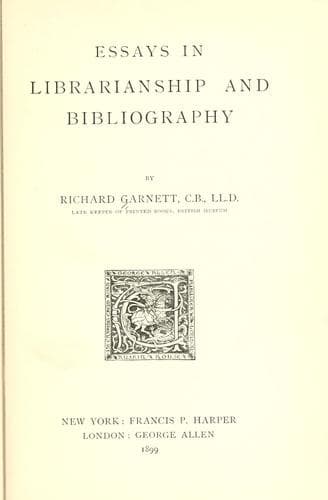
Essays in Librarianship and BibliographyGarnett, Richard
Science
Essays in Librarianship and Bibliography
Garnett, Richard
Bibliography -- Methodology; British Museum; Library science
his ingenious ideas forward for the general good. I hope he will do so,
either at this meeting, or ere long in the pages of THE LIBRARY, or some
other suitable medium. I shall not attempt to trespass upon his ground,
but will very briefly make a suggestion for book accommodation in a
restricted space, which his ingenious contrivances may have prompted,
although to find its exact prototype we must go back to the earliest
libraries that have ever existed.
These, as we all know, were the libraries of the kings of Babylon and
Assyria. Paper and parchment not having been then invented, literature
could only be inscribed on some hard substance. Wood or metal might have
been used, but the substances employed by the Assyrians seem to have
been almost exclusively stone, clay, or terra cotta. An incised stone
slab may be an excellent vehicle for a brief record intended to remain
fixed in the same place, but for a chronicle or a liturgy, or a set of
astronomical observations, or any other of the staple productions of
Babylonian or Assyrian literature it is objectionable in two
respects—it is profuse of space, and it is not easily portable. The
King of Assyria, like the King of Persia of a later date, had doubtless
frequent occasion to send for the chronicles of his kingdom to refresh
his memory respecting the treason of some Bigthan or Teresh, or the
services of some Mordecai. The Assyrian historians or librarians,
therefore, devised the inscription of their literature upon cylinders,
usually hexagonal prisms, giving six faces instead of one, and
possessing the double advantage of easy portability, and of bringing the
largest amount of writing possible into the smallest possible space. The
question of portability does not concern us now (though I may remark
incidentally that in very extensive libraries it offers a decisive
argument against the card catalogue), but it does appear to me worthy of
consideration whether, in endeavouring to make room for our books, we
might not occasionally employ the hexagonal form of press, fixed or
revolving, and thus revert with advantage to the method which our most
primitive predecessors adopted to make room for their writings. The
hexagonal prism has the advantage of affording more space practically
available within less area than any other geometrical figure. It seems
well adapted for use in the central area of large rooms as a supplement
to the wall space; for the extension of wall space when presses are run
out from the sides towards the centre of the room; and for the storage
of valuable books or other objects which it is desirable to keep apart.
A case of this description could be partially glazed to allow of the
exhibition of a portion of the contents level with the eye; and many
other applications might probably be found for the hexagonal book-press
or cabinet in libraries constructed with an especial view to its
introduction. It may be that such presses or cabinets, admitting as they
Public-domain text, read in full here on John Shaqi.
Reviews
Reviews
No reviews yet
Be the first to share your thoughts on this work.
Elsewhere in the archive
Join the Discussion
Join the discussion
Sign in to leave a comment or review.
Sign InorCreate an account