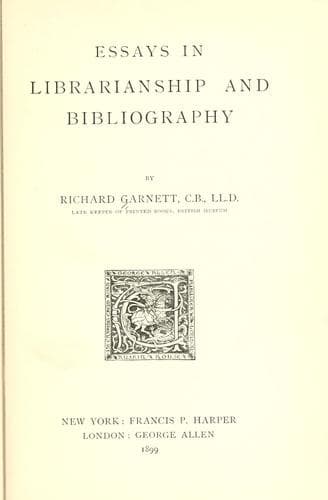
Essays in Librarianship and BibliographyGarnett, Richard
Science
Essays in Librarianship and Bibliography
Garnett, Richard
Bibliography -- Methodology; British Museum; Library science
would of being made of any degree of strength, or of being lined or
protected in any manner, and of being wholly or partially glazed or
unglazed as desired, would be best of all adapted for the custody of
objects of art or archæology—"infinite riches in a little room." Yet,
even if so, libraries and museums are so frequently under the same
management that the subject cannot be deemed inappropriate for a
congress of librarians.
I will finally mention another method of obtaining increased space for
the display of books, MSS., and other exhibited objects. The lower part
of ordinary bookcases can be converted into show-cases by placing
against them, attached or unattached, light tables with glazed tops,
resting on wheels to allow of easy withdrawal when access to the case is
required. This would greatly increase the exhibition space in libraries
and museums, and might sometimes allow the centre of a fine room to be
free from obstruction, and available for lectures and meetings. Applied
to ordinary wall cases, it might admit of the display of many objects
supposed to be exhibited, but which in reality are not so, being placed
too high or too low to be seen.
FOOTNOTES:
[272:1] Read at the Annual Meeting of the Library Association, Belfast,
September 1894.
[272:2] A paper by Mr. H. M. Mayhew, of the British Museum, on "A
Revolving Extension Press."
PREFACE TO BLADES' "ENEMIES OF BOOKS"[283:1]
The precept "Love your Enemies" was never intended for the enemies of
books, because the enemy of books is not an individual foe, but _hostis
humani generis_. The value of books, as of other things, may be
superstitiously overrated. We are accustomed to speak of them as if they
were in themselves the wisdom, or the knowledge, or the genius, of which
they are, in fact, only the receptacles. They are not the honey of the
human hive, but only the treasure-cells in which it is stored, and the
analogue of the bee is the author. But even in this restricted point of
view, their function is so important that to destroy them is a crime of
_lèse-humanité_; and it is not known that any one ever enunciated their
destruction as a sound principle, unless it were the Caliph Omar. Even
he, if the famous _bon-mot_ attributed to him is genuine, was willing to
spare one book; and could his life have been prolonged for a century or
two, he would have discovered that in reprieving the Koran he had
authorised the creation of a very considerable literature. The number of
commentaries upon the Koran actually existing is not small; what would
it have been had it been necessary to prove that all history, and
geography, and astronomy, and everything else that man needed to know,
was implicitly taught therein?
Public-domain text, read in full here on John Shaqi.
Reviews
Reviews
No reviews yet
Be the first to share your thoughts on this work.
Elsewhere in the archive
Join the Discussion
Join the discussion
Sign in to leave a comment or review.
Sign InorCreate an account