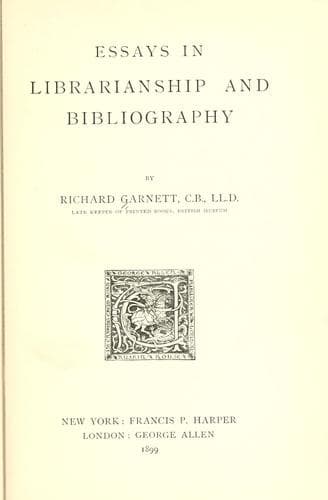
Essays in Librarianship and BibliographyGarnett, Richard
Science
Essays in Librarianship and Bibliography
Garnett, Richard
Bibliography -- Methodology; British Museum; Library science
The Royal Commission of 1847-49 deserves to be considered the
turning-point of Sir A. Panizzi's administration. Up to this time,
however caressed in highly cultivated circles, he had been unpopular
with the public, who could not be expected to know how his plans were
cramped and thwarted, and were in many instances illiberally prejudiced
against him as a foreigner. The Commission gave him a welcome
opportunity of at once challenging inquiry into complaints, and of
making known the signal improvements already effected by him. His
invitation to complainants to come forward—widely circulated through
the notice taken of it by this journal—elicited a number of attacks,
which, with the replies, may be found in the Parliamentary Blue Book,
and form as instructive and amusing a body of reading as ever Blue Book
contained. The Commissioners, who included men of letters like Lord
Ellesmere, and men of business like Lord Canning and the present Duke of
Somerset, could but report that not one charge had been established in
any single particular. It is abundantly clear that very few of the
complainants had any definite notion of what they wanted, and the
frivolousness of their imputations, even had they been well founded,
arouses something like indignation when contrasted with the immense
services which Panizzi was at the time rendering without receiving any
credit at all. This triumphant vindication of his management, however,
made him omnipotent with the Trustees and the Government, and paved the
way for the greatest undertaking of his life. It is needless to describe
a structure so familiar to all English men of letters as the new Reading
Room. The original design, sketched by Mr. Panizzi on April 18, 1852,
was submitted to the Trustees on May 5 following. By May 1854, its
originator's indomitable perseverance and extensive influence had
prevailed to obtain the large grant necessary for the commencement of
the work, which was completed and opened to the public in May 1857. The
part generally visible—Mr. Smirke's contribution to the plan—though
architecturally the most imposing, is hardly the most remarkable portion
of a structure providing space for three hundred readers and a million
volumes on ground previously wasted and useless. Every detail was either
devised or superintended by Sir A. Panizzi, and it is not too much to
affirm that no edifice has existed more perfectly reconciling grandeur
of general effect with an accurate adaptation of means to ends in the
very smallest things. One thing alone is wanting, that the reference
library should be as far above competition as the Reading Room, and
this, too, will be accomplished when the exigencies of space allow the
present Principal Librarian's plans to be carried out. The attempts that
have been made to deprive Sir A. Panizzi of the credit of the conception
are futile. Any one could see that the space in the quadrangle was
wasted. The present writer himself made the remark to an officer of the
Public-domain text, read in full here on John Shaqi.
Reviews
Reviews
No reviews yet
Be the first to share your thoughts on this work.
Elsewhere in the archive
Join the Discussion
Join the discussion
Sign in to leave a comment or review.
Sign InorCreate an account