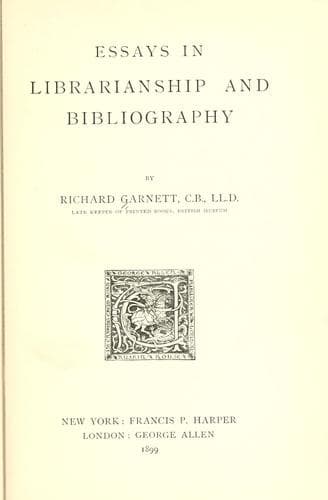
Essays in Librarianship and BibliographyGarnett, Richard
Science
Essays in Librarianship and Bibliography
Garnett, Richard
Bibliography -- Methodology; British Museum; Library science
Museum at the age of fourteen. But it was one thing to discern the evil
and another to provide the remedy.
In 1856 Sir A. Panizzi succeeded Sir Henry Ellis as Principal Librarian,
being himself succeeded as Keeper of the Printed Books by Mr. Winter
Jones. His administration of the Museum as a whole was carried on in the
same spirit as his administration of the library, but, except for the
great impetus given to purchases generally, was not distinguished by
equally striking incidents. His work for the library had been mostly
performed, and the affairs of the other departments afforded less scope
for the display of his peculiar qualities. Two or three slight
administrative mistakes may be admitted without derogation to his fame,
for they can be shown to have originated in every instance from an
excessive regard for what he himself considered the true interests of
his subordinates. This was ever a passion with him, and every
improvement in the position of the officials of the Museum effected
during his connection with the establishment may be traced to his
influence. Exhausted at length with work, he retired on his full salary
in July 1866. He took up his residence in Bloomsbury Square, almost
within call of the Museum, and ceased not to the last to exhibit the
warmest interest in the institution. In 1869 he accepted the honour of
knighthood, which he had frequently declined. His death on April 8 has
already been recorded in our pages.
Little can be said here of Sir A. Panizzi's activity as a politician and
patriot. It was probably little less important or beneficial than his
activity as a librarian, and possibly occupied hardly less of his time
and thoughts. It was, however, wholly below the surface, and the
materials for defining and appreciating it are at present wanting. There
can be no question that he served the cause of Italy most effectually by
his intimacy with the leading English statesmen, who admired and
confided in him. Thoroughly Anglicised, he knew how to appreciate the
currents of English sentiment, and predicted to Lord Palmerston that the
Conspiracy Bill would occasion the downfall of his government. With this
statesman, as well as Lord Russell, he was most intimate; and he
received touching proofs in his last illness of the regard of Mr.
Gladstone, whose famous pamphlet on the Neapolitan prisons sounded a
note originally struck by Panizzi. Sir James Hudson, the English Envoy
at Turin, was one of his most trusted friends, and their mutual
understanding was of great service to the Italian cause. Cavour
thoroughly confided in him, and vainly tempted him to a political career
in Italy by the offer of a senatorship. Though devoted to the house of
Savoy, he cordially sympathised with Garibaldi, in whose English
reception he had a great share, and whom he accompanied on that occasion
to the tomb of Ugo Foscolo. He reckoned the Orleans princes among his
friends, and a community of literary tastes especially linked him to the
Public-domain text, read in full here on John Shaqi.
Reviews
Reviews
No reviews yet
Be the first to share your thoughts on this work.
Elsewhere in the archive
Join the Discussion
Join the discussion
Sign in to leave a comment or review.
Sign InorCreate an account