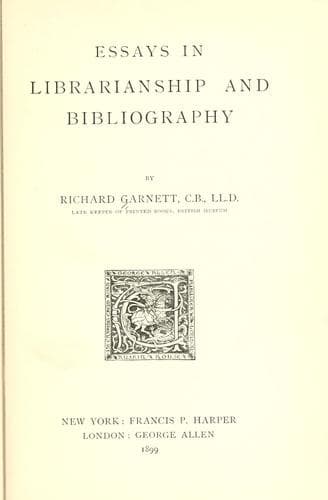
Essays in Librarianship and BibliographyGarnett, Richard
Science
Essays in Librarianship and Bibliography
Garnett, Richard
Bibliography -- Methodology; British Museum; Library science
Henry Stevens was born August 24, 1819, at Barnet, Vermont, U.S., hence
the initials, G.M.B. (Green Mountain Boy), prized by him, there is
reason to surmise, above his academical and antiquarian distinctions. He
was sixth in descent from Cyprian Stevens, who had emigrated in the days
of Charles I. The family came originally from Devonshire. It had had
its share of colonial celebrity and adventure; one ancestor had
successfully defended a fort against the French; another had been stolen
by the Indians, and ransomed for a pony. After receiving a fair ordinary
education at the school of his native village, and two local seminaries,
Mr. Stevens, at the age of seventeen, began to teach with a view of
obtaining means to take him to college. He received from twelve to
sixteen dollars a month, boarding with his pupils' families, "three days
to a scholar, except when the girls were pretty, and in that case four."
In October 1838 he proceeded to Middlebury College, defraying his
travelling expenses by peddling cheeses contributed for that purpose by
his excellent mother. His father, a man of literary tastes and culture,
founder and President of the Vermont Historical and Antiquarian Society,
seems to have been always behindhand with the world, and to have been
unable to aid his son to any material extent. It was customary for
students thus destitute of support from home to defray their college
expenses by teaching in the winter months. Stevens obtained leave to try
his fortune at Washington, relying on the patronage of Governor Henry
Hubbard, then Senator for New Hampshire. He called upon him accordingly,
and though he was a Whig and the Senator a Democrat, he found himself,
as if by magic, clerk in the Treasury Department "in charge of the
records and correspondence of the Revenue Cutter Service," with a salary
of a thousand dollars a year. He was soon afterwards transferred to a
clerkship in the Senate, where after a while he was employed as clerk to
the Senate branch of the Joint Committee of the Congress for
investigating the claims of Messrs. Clark & Force under a contract for
publishing the American Archives, which it was desired to terminate.
Much time and labour had been expended upon the volumes already printed,
but it was generally surmised that the contract would be broken,
because, as a Democrat remarked, "it would cost more than the building
of the Capitol, and, what was worse, both the editor and the printer
were Whigs." The Committee, who seem to have had no taste for literary
drudgery, turned the task of digesting the papers entirely over to Mr.
Stevens, who on his part, finding the documents intrusted to him
insufficient, scraped acquaintance with Colonel Peter Force himself, and
extracted abundant information from him without divulging his official
position. At length the digest was ready, and the Committee, convoked
for the purpose, heard their officer read the whole, up to the entirely
Public-domain text, read in full here on John Shaqi.
Reviews
Reviews
No reviews yet
Be the first to share your thoughts on this work.
Elsewhere in the archive
Join the Discussion
Join the discussion
Sign in to leave a comment or review.
Sign InorCreate an account