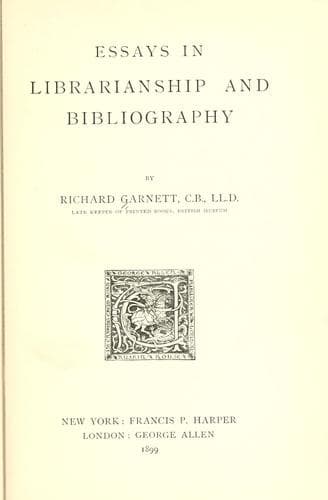
Essays in Librarianship and BibliographyGarnett, Richard
Science
Essays in Librarianship and Bibliography
Garnett, Richard
Bibliography -- Methodology; British Museum; Library science
unexpected and unwelcome conclusion, "Resolved, that this contract
cannot be broken." Stevens was severely taken to task for his
presumption, when Daniel Webster, a member of the Committee, interfered
on his behalf, and advocated his view with such effect that "the
Committee was discharged from further consideration of the subject." The
contract was shortly afterwards rescinded. The service Stevens had
nevertheless rendered to Force had an important influence on his
subsequent career. Quitting Washington, as he had always intended to do,
and repairing to complete his education at Yale College, he took with
him a commission from the Colonel to collect books, pamphlets, and MSS.
in aid of the American Archives, which not only helped to provide the
expenses of his University course, but endowed him with knowledge,
tastes, and aptitudes qualifying him for future eminence as book-hunter
and bookseller. Another main source of income was his fine penmanship,
both as transcriber and teacher. He took his B.A. degree in 1843, and in
1843-44 studied law at Harvard under Justice Story, continuing to act as
agent for Colonel Force, and forming connections with other collectors.
At length, in 1845, he determined to visit England on literary errands,
not expecting to be absent more than one or two years. Fortified by
introductions from Francis Parkman and Jared Sparks, he took his
departure, and in July 1845 found himself at the North and South
American Coffee-House, the bearer of a huge bag of despatches for the
United States Minister, Mr. Everett, and of a tiny one of forty
sovereigns of his own. Mr. Everett's influence opened the State Paper
Office to him; and ere the sun set on his first day in London he had
visited the four great second-hand dealers of the day, Rodd, Thorpe,
Pickering, and Rich. The last-named had just acquired the valuable
library of M. Ternaux-Compans, and Mr. Stevens immediately purchased
£800 worth on behalf of Mr. John Carter Brown of Providence, Rhode
Island, from whom he had a general commission to forage, and who showed
wisdom as well as spirit in ratifying his agent's decided action. Those
were the golden days of speculation in books relating to America, when
rarities could be obtained for hardly more shillings than they now cost
pounds. Mr. Stevens probably contributed more than any other man to
terminate this happy state of things. While, on the one hand, he
ransacked the chief European capitals as agent for wealthy American
collectors, on the other hand he drained America on behalf of the
British Museum, then for the first time entering into the market to any
considerable extent. Mr. Panizzi had just prepared his celebrated report
on the deficiencies of the Museum Library, in which he had said: "The
expense requisite for accomplishing what is here suggested—that is, for
forming in a few years a public library containing from 600,000 to
700,000 printed volumes, giving the necessary information on all
Public-domain text, read in full here on John Shaqi.
Reviews
Reviews
No reviews yet
Be the first to share your thoughts on this work.
Elsewhere in the archive
Join the Discussion
Join the discussion
Sign in to leave a comment or review.
Sign InorCreate an account