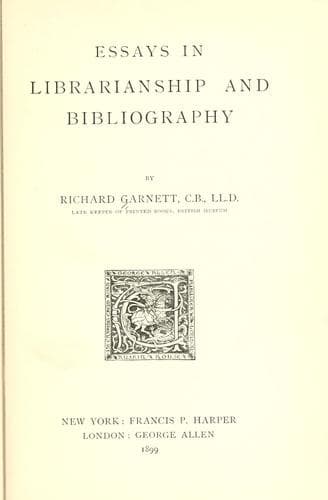
Essays in Librarianship and BibliographyGarnett, Richard
Science
Essays in Librarianship and Bibliography
Garnett, Richard
Bibliography -- Methodology; British Museum; Library science
It seems almost preposterous to speak of typography as a scientific
process, yet such it is in its relation to the graphic art which it
superseded as an agent in the production of books. It would be the
merest surplusage to advocate the application of printing to any class
of manuscript books but one; and that, strangely enough, is the book of
books, the catalogue. When it is considered how few of the great
libraries of Europe have as yet managed to get their catalogues printed,
and in how many the introduction of print is as yet resisted, or beset
with impediments hitherto insurmountable, it is clear that the benefits
of printing may even now be set forth with profit. Fortunately, however,
the question is but historical as regards the only library of which the
present writer can presume to speak. Typography has now reigned at the
British Museum for nearly twenty years, and any discussion of its
advantages or disadvantages contained in the following essays may be
regarded as out of date. It is hoped, nevertheless, that the historical
interest attaching to the subject may excuse the reproduction of these
papers. "Public Libraries and their Catalogues" (1879) depicts the
hesitations of a transition period when the subject was in the air, but
when the precise manner in which the introduction of print would take
place was as yet uncertain. "The Printing of the British Museum
Catalogue" (1882) describes the results of nearly two years of actual
work; and "The Past, Present, and Future of the British Museum
Catalogue" (1888) reviews the entire subject, both historically and with
a view to the eventual republication of the catalogue. A fourth paper,
contributed to the American Library Conference of 1885, has been
withheld, to minimise the repetition which may be justly alleged as a
defect in the essays now reprinted. The indulgent reader will consider
that it was impossible to travel repeatedly over the same ground
without frequent recurrence to the same facts and arguments: and it has
been thought better to tolerate an admitted literary blemish than to run
any risk of impairing the documentary value of the articles. If the
writer had once begun to alter, he might have been tempted to alter
much. Readers of the present day may feel surprise at the tentative
character of some portions of the first essay in order of date, and at
what seems almost a discouragement of the idea of a complete printed
catalogue. The principal reason was the moderate expectation then
entertained of any substantial help from the Treasury. As a matter of
fact, the annual grant bestowed in the first instance would have kept
the catalogue forty years at press; and, had a strictly alphabetical
order of publication been adopted, it would after some years have been
pointed out with derision that the great British Museum Catalogue was
still in its A B C. The writer, therefore, exerted what influence he
possessed to keep the idea of a complete printed catalogue in the
Public-domain text, read in full here on John Shaqi.
Reviews
Reviews
No reviews yet
Be the first to share your thoughts on this work.
Join the Discussion
Join the discussion
Sign in to leave a comment or review.
Sign InorCreate an account