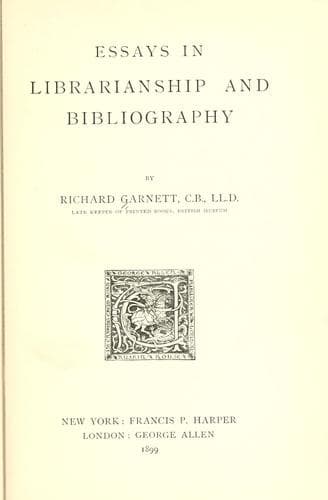
Essays in Librarianship and BibliographyGarnett, Richard
Science
Essays in Librarianship and Bibliography
Garnett, Richard
Bibliography -- Methodology; British Museum; Library science
and a department of the public service, and that it is only by these
matters being thus generally regarded that the librarian can render full
service to the public, or the public full justice to the librarian.
We now propose to offer a few observations on some of the points of
principal national concern connected with the administration of
libraries in general, and, as from this point of view is inevitable, of
the national library in particular. In so doing we must acknowledge our
special obligations to the following works, and recommend them to the
study of all interested in library subjects; 1. The Transactions and
Proceedings of the Conference of Librarians held in London, October
1877, edited by E. B. Nicholson and H. R. Tedder: Chiswick Press. 2. The
_Library Journal_, official organ of the Library Associations of America
and of the United Kingdom: Trübner. 3. Public Libraries in the United
States of America; Special Report. Washington: Bureau of Education. To
these may be added Mr. Axon's able article on the Public Libraries of
America in the last number of the "Companion to the Almanac."
It might seem that not much could be said respecting the mere purchase
of books, but even this department is subject to the general law of
specialisation, and the character of a collection must vary as it falls
within the category of national, academical, or municipal libraries. The
mission of the national library is the simplest: its character is
determined for it by the enactment which in most civilised states
constitutes it the general receptacle of the national literature, good,
bad, and indifferent, and imposes the corresponding obligation of
rendering itself the epitome of foreign literatures, as far as its means
allow. Every such library is the mirror of its time, and perhaps even
its services to contemporaries are of less real account than those which
it performs for posterity in preserving the image of the past. This is
the apology of the librarian's anxiety to collect what the uninitiated
regard as trash. Yesterday's news-sheet, waste paper to-day, will be
precious after a century, and invaluable after a millennium. The same
principle justifies the heavy expenditure which it is frequently
necessary to occur in procuring what is truly illustrative of the
history of a life or a nation, even when it comes in the costly shape of
a bibliographical rarity. A black-letter ballad on a Smithfield
martyrdom, a collection of cuttings illustrating Byron or Dickens, must
be secured for the national Museum if at all within the compass of its
resources. Hardly as much can be said for another class of rarities—the
vellum page or the sumptuous binding which makes a volume a work of art,
but adds nothing to the value or significance of its contents. Such
luxuries, the darlings of the genuine bibliographer, the tests of his
professional taste and the _chevaux de bataille_ of his collection, are
Public-domain text, read in full here on John Shaqi.
Reviews
Reviews
No reviews yet
Be the first to share your thoughts on this work.
Join the Discussion
Join the discussion
Sign in to leave a comment or review.
Sign InorCreate an account