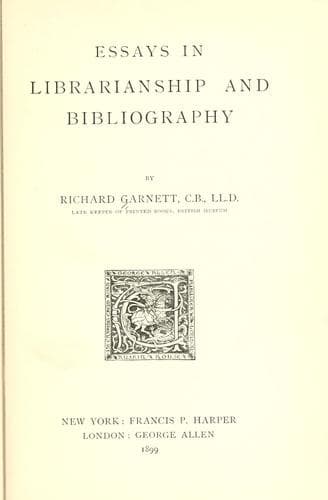
Essays in Librarianship and BibliographyGarnett, Richard
Science
Essays in Librarianship and Bibliography
Garnett, Richard
Bibliography -- Methodology; British Museum; Library science
We must hold, then, that the alphabetical index of subjects should be
the auxiliary and complement of the Alphabetical Catalogue, not a part
of it; that each book should be entered in it, as in the catalogue, once
and once only; that the minor indexes should be grouped together so as
to form collectively a whole (_e.g._ ornithology and ichthyology, as
sub-sections of zoology); and that the operations of cataloguing and
indexing should go on _pari passu_. If this is attended to for the
future, the future will take care of itself; but "not Heaven itself upon
the past has power," and it is discouraging to think upon the immense
leeway which remains to be made up in most of our great public
libraries. The experience of the Bodleian will be very valuable, and we
must confess to much curiosity to see how long the operation of
classifying its multifarious contents will take. In the British Museum
the foundation of a classed catalogue has already been laid by a simple
process. As fast as the titles have been transcribed for insertion in
the three copies of the catalogue by a manifold writer, a fourth copy
has been taken, and this copy is arranged in the order of the books on
the shelves. As the various subjects are kept together in the library,
such an arrangement is practically equivalent to a rough classed
catalogue, which could be digested into order with comparative facility.
The publication of such a classified index, reduced to the utmost
possible brevity, offers, as it seems to us, the best solution of the
vexed question of the publication of the Museum Catalogue. On this point
much remains to be said. Meanwhile, before quitting the subject of
cataloguing methods, a tribute is due to Mr. Cutter's important
contribution to the subject, in his rules for his Dictionary Catalogue.
Next after the settlement of the Museum rules in 1839, these form the
most important epoch in the history of cataloguing. Agreeing with the
latter rules in the main, and when differing, generally, as we must
think, not differing for the better, they nevertheless contain a most
valuable body of acute reasoning and apt illustration, which it did not
fall within the province of the Museum authorities to provide; they
bring unusual experience and ability to bear upon the intricate subject
of classification, and are further reinforced by most ingenious remarks
on the economy and manipulation of print, making the mere variations of
type instructive.
Public-domain text, read in full here on John Shaqi.
Reviews
Reviews
No reviews yet
Be the first to share your thoughts on this work.
Join the Discussion
Join the discussion
Sign in to leave a comment or review.
Sign InorCreate an account