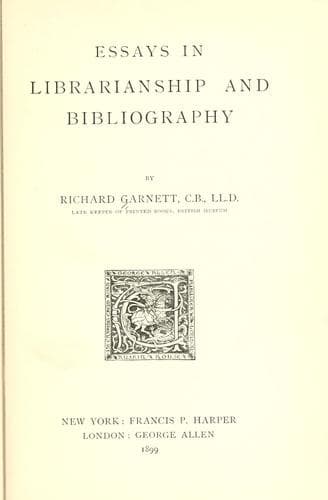
Essays in Librarianship and BibliographyGarnett, Richard
Science
Essays in Librarianship and Bibliography
Garnett, Richard
Bibliography -- Methodology; British Museum; Library science
Print and the sliding-press are now, along with the electric light,
undisputed possessions of the Museum; but telegraphy and photography,
the two other applications of scientific ingenuity recommended in this
volume, have not yet been enlisted in her service. When the printing
telegraph obtains a footing, ample occupation will be found for it. Its
most useful as well as most striking application, however, will probably
always be the one principally dwelt upon here, the enabling every demand
for a book made in the reading-room to be simultaneously registered in
the Library, thus abolishing at a stroke the vexatious delays that now
intervene between the writing of a ticket and its delivery in the proper
quarter. The advantage alike to the public and to the staff is so
obvious that the only question ought to be as to the applicability of
electrical power to the transmission of legible messages under the
special circumstances, which an intelligent course of experiments would
speedily determine.
If telegraphy has been neglected, the same cannot be said of
photography. The most perfect unanimity exists within and outside the
Museum with respect to the benefit which the adoption of photography as
a department of the regular work of the institution would confer alike
upon it and upon the public. Nevertheless, not a single step has been
taken since the writer brought the subject forward in 1884, preceded as
this had been by the successful introduction of photography at the
Bodleian Library in connection with the Oxford University Press.
Government seems unable to perceive the public benefit to be derived
from the cheap reproduction and unlimited multiplication with infallible
accuracy of historical documents and current official papers; and
although the Museum has of late successfully resorted to photography for
its own publications, this has necessarily involved the employment of a
professional photographer, whose charges are an insuperable impediment
to any considerable extension of the system. It cannot be too
emphatically reiterated that the question is entirely one of expense. So
long as the photographer is a private tradesman he must of necessity be
paid by his customers, and for any extensive undertaking must inevitably
charge prices embarrassing to public institutions and prohibitive to
private individuals. Make him a public salaried officer, and by far the
larger part of the cost is eliminated at a stroke. What may be done is
shown by the recent exploit of the Newbery Library at Chicago, referred
to in a note at page 86, which has turned the bewildering multitude of
the "accession" parts of the British Museum Catalogue into a single
alphabetical series by simply photographing the titles singly, and then
combining the copies in a catalogue. It is quite possible that the
enterprise may prove financially unremunerative, but this would not be
the case if it had been executed as a portion of the work of a national
Public-domain text, read in full here on John Shaqi.
Reviews
Reviews
No reviews yet
Be the first to share your thoughts on this work.
Join the Discussion
Join the discussion
Sign in to leave a comment or review.
Sign InorCreate an account