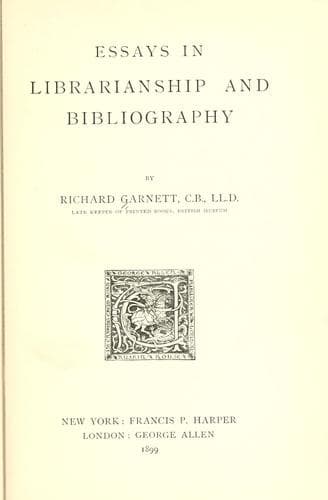
Essays in Librarianship and BibliographyGarnett, Richard
Science
Essays in Librarianship and Bibliography
Garnett, Richard
Bibliography -- Methodology; British Museum; Library science
Before leaving India, I may mention a remarkable circumstance, not, so
far as I know, hitherto recorded in typographical history. It appears
from that marvellously interesting book, too soon interrupted, Mr.
Sainsbury's "Calendar of the Papers of the East India Company," that in
1624 the Shah of Persia, "having an earnest desire to bring into his
country the art of printing," was "very importunate" with the agents of
the Company at Ispahan, "to write for men skilful in the science, whom
he promises to maintain at his own charge." It does not appear that the
Company, who were then meditating the relinquishment of their Persian
branch as unprofitable, took any steps to fulfil the Shah's wishes, and
of course the casting of Oriental types in Persia, or their transport
thither, would have been very difficult undertakings. But the desire to
endow Persia with a printing-press nevertheless reflects the highest
honour upon the Shah, who was no less famous a person than Abbas the
Great.
From India we pass to China, and here an important discovery has been
made of late years. It has until very lately been universally believed
that the first book printed by Europeans in China was Eduardus de Sande,
"De Missione legatorum Japanensium ad Romanam Curiam" (Macao, 1590). My
friend, Señor José T. Medina, the Hercules and Lynceus of South American
bibliographers, has, however, found from the book itself that this
cannot be the case, for the writer of the preliminary address, Alexander
Valignanus, states that he has himself previously published at the same
place a book by Joannes Bonifacius, "De honesta puerorum institutione."
This must have appeared in 1589, if not sooner, and is undoubtedly the
first book printed by Europeans in China. Unfortunately it cannot be
produced, for it is not to be found. A copy may still be lurking in some
ancient library, and great will be his merit who brings it to light. It
may be mentioned that although the book "De Missione" principally
relates to Europe, and was compiled under the fiction of imaginary
conversations with the Japanese ambassadors (who really had visited
Europe and returned) for the information of the Japanese pupils of the
Jesuits, one chapter is an account of China for the benefit of European
readers. It is full of interest; and although its particulars have long
become common property, it would be well worth translating as a
contemporary account. Sande's book, it is needless to state, is of
exceeding rarity. It may be seen in a show-case in the King's library at
the British Museum, side by side with the very oldest South American
books.
Public-domain text, read in full here on John Shaqi.
Reviews
Reviews
No reviews yet
Be the first to share your thoughts on this work.
Elsewhere in the archive
Join the Discussion
Join the discussion
Sign in to leave a comment or review.
Sign InorCreate an account