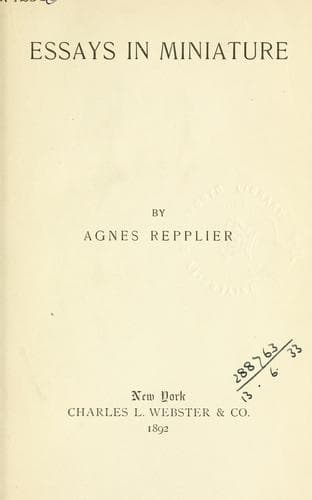
American essays -- 19th century; Literature -- History and criticism
But alas! this may not be. We have but the memories of past good cheer;
we have but the echoes of departed laughter. In vain we look and listen
for the mirth that has died away. In vain we seek to question the gray
ghosts of old-time revelers.
“Still shall this burden their answer bear,
What has become of last year’s snow?”
CHILDREN IN FICTION
Mr. Rudyard Kipling has prefaced his little volume of _Child Stories_
with a modest intimation that he finds the subject almost beyond his
grasp. He says:
“Only women understand children thoroughly; but if a mere man
keeps very quiet, and humbles himself properly, and refrains
from talking down to his superiors, the children will sometimes
be good to him, and let him see what they think about in
the world. Yet, even after patient investigation and the
condescension of the nursery, it is hard to draw babies.”
This sounds disarming, and at the same time strikes a popular note
respecting these fortunate little people, who, after having been
considered for many years as unworthy of the novelist’s regard, have now
suddenly grown too complex and subtle for him to hope to understand. Mr.
Kipling himself approaches them with great caution, and treats them with
careful conventionality, except in that pitiful bit of realism, “Baa,
Baa, Black Sheep,” where the misery and swift deterioration of a child
are almost too painfully portrayed. Punch, with his dim comprehension of
his own unhappiness, and his pathetic attempts to be friendly and “oblige
everybody;” Punch, swaying alternately from clumsy deception to helpless
rage, badgered into sullenness, and betrayed by the inherent weakness of
his poor, peace-loving little soul, is a picture burdened with bitter
truth, drawn with revengeful fidelity. Once, I am sure, a half-blind,
solitary boy measured those lonely rooms in hand spans: “fifty down the
side, thirty across, and fifty back again—one hundred and eighty-one
exactly from the hall door to the top of the first landing.” Once, I am
sure, he knocked his blundering head against the walls, and upset the
glasses that he tried to grasp, in the gathering gloom of his doubly
darkened life.
Public-domain text, read in full here on John Shaqi.
Reviews
Reviews
No reviews yet
Be the first to share your thoughts on this work.
Join the Discussion
Join the discussion
Sign in to leave a comment or review.
Sign InorCreate an account