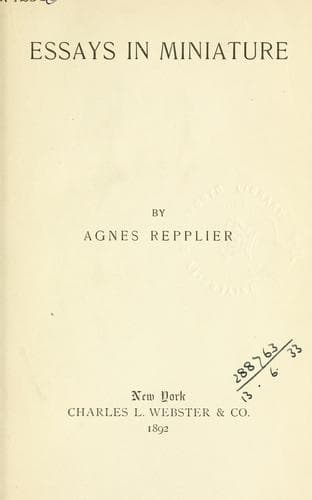
American essays -- 19th century; Literature -- History and criticism
and that no man was under any obligation to read what another man wrote.
This is an old-fashioned point of view, which has lost favor of late
years, but which is not without compensations of its own. If the office
of literature be to make glad our lives, how shall we seek the joy in
store for us save by following Hazlitt’s simple suggestion, and reading
“with all the satisfaction in our power”? And how shall we insure this
satisfaction, save by ignoring the restrictions imposed upon us, and
cultivating, as far as we can, a sincere and pleasurable intercourse with
our friends, the books?
TRIALS OF A PUBLISHER
In reading the recently published _Memoirs and Correspondence of John
Murray_, a very interesting and valuable piece of biography—albeit
somewhat lengthy for these hurried days—we are forcibly impressed
with one surprising truth which we were far from suspecting in our
ignorance—namely, that the publisher’s life, like the policeman’s, is
not a happy one, but filled to the brim with vexations peculiarly his
own. It was as much the fashion in Murray’s time as it is in ours to
bewail the hard fate of down-trodden authors, and to hint that he who
prints the book absorbs the praise and profit which belong in justice to
him who writes it. In fact, that trenchant and time-honored jest, “Now
Barabbas was a publisher,” dates from this halcyon period when _Marmion_
was sold for a thousand guineas, and the third canto of _Childe Harold_
for nearly twice that sum. Murray himself possessed such influence in the
literary world that the battle with the public was thought to be half won
when a book appeared armed with the sanction of his name. He was a man of
wealth, too, of social standing, of severe and fastidious tastes; exactly
fitted by circumstances, if not by nature, to play the autocratic _rôle_
popularly assigned to all his craft, to crush the aspiring poet in the
dust, to freeze the budding genius who sought assistance at his hands, to
override with haughty arrogance the wan and needy scholar who waited at
his door. Instead of this, we see him enduring with lamblike gentleness
an amount of provocation which would have hallowed a mediæval saint, and
which seems to our undisciplined spirits as wantonly exasperating and
malign.
Public-domain text, read in full here on John Shaqi.
Reviews
Reviews
No reviews yet
Be the first to share your thoughts on this work.
Join the Discussion
Join the discussion
Sign in to leave a comment or review.
Sign InorCreate an account