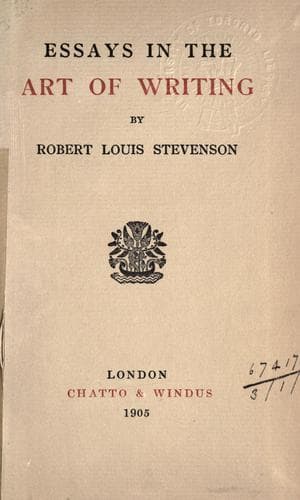
Essays in the Art of WritingStevenson, Robert Louis
History
Essays in the Art of Writing
Stevenson, Robert Louis
Authorship; Literature -- History and criticism; Stevenson, Robert Louis, 1850-1894 -- Authorship
But a fact may be viewed on many sides; it may be chronicled with rage,
tears, laughter, indifference, or admiration, and by each of these the
story will be transformed to something else. The newspapers that told of
the return of our representatives from Berlin, even if they had not
differed as to the facts, would have sufficiently differed by their
spirits; so that the one description would have been a second ovation,
and the other a prolonged insult. The subject makes but a trifling part
of any piece of literature, and the view of the writer is itself a fact
more important because less disputable than the others. Now this spirit
in which a subject is regarded, important in all kinds of literary work,
becomes all-important in works of fiction, meditation, or rhapsody; for
there it not only colours but itself chooses the facts; not only modifies
but shapes the work. And hence, over the far larger proportion of the
field of literature, the health or disease of the writer’s mind or
momentary humour forms not only the leading feature of his work, but is,
at bottom, the only thing he can communicate to others. In all works of
art, widely speaking, it is first of all the author’s attitude that is
narrated, though in the attitude there be implied a whole experience and
a theory of life. An author who has begged the question and reposes in
some narrow faith cannot, if he would, express the whole or even many of
the sides of this various existence; for, his own life being maim, some
of them are not admitted in his theory, and were only dimly and
unwillingly recognised in his experience. Hence the smallness, the
triteness, and the inhumanity in works of merely sectarian religion; and
hence we find equal although unsimilar limitation in works inspired by
the spirit of the flesh or the despicable taste for high society. So
that the first duty of any man who is to write is intellectual.
Designedly or not, he has so far set himself up for a leader of the minds
of men; and he must see that his own mind is kept supple, charitable, and
bright. Everything but prejudice should find a voice through him; he
should see the good in all things; where he has even a fear that he does
not wholly understand, there he should be wholly silent; and he should
recognise from the first that he has only one tool in his workshop, and
that tool is sympathy. {64}
The second duty, far harder to define, is moral. There are a thousand
different humours in the mind, and about each of them, when it is
uppermost, some literature tends to be deposited. Is this to be allowed?
Not certainly in every case, and yet perhaps in more than rigourists
would fancy. It were to be desired that all literary work, and chiefly
works of art, issued from sound, human, healthy, and potent impulses,
whether grave or laughing, humorous, romantic, or religious.
Public-domain text, read in full here on John Shaqi.
Reviews
Reviews
No reviews yet
Be the first to share your thoughts on this work.
Join the Discussion
Join the discussion
Sign in to leave a comment or review.
Sign InorCreate an account