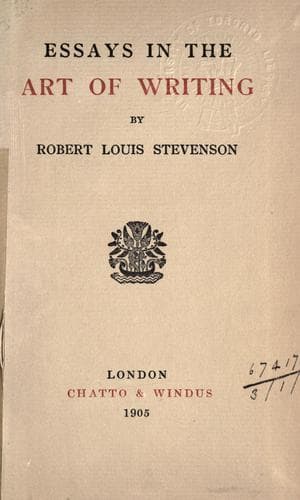
Essays in the Art of WritingStevenson, Robert Louis
History
Essays in the Art of Writing
Stevenson, Robert Louis
Authorship; Literature -- History and criticism; Stevenson, Robert Louis, 1850-1894 -- Authorship
But of works of art little can be said; their influence is profound and
silent, like the influence of nature; they mould by contact; we drink
them up like water, and are bettered, yet know not how. It is in books
more specifically didactic that we can follow out the effect, and
distinguish and weigh and compare. A book which has been very
influential upon me fell early into my hands, and so may stand first,
though I think its influence was only sensible later on, and perhaps
still keeps growing, for it is a book not easily outlived: the _Essais_
of Montaigne. That temperate and genial picture of life is a great gift
to place in the hands of persons of to-day; they will find in these
smiling pages a magazine of heroism and wisdom, all of an antique strain;
they will have their ‘linen decencies’ and excited orthodoxies fluttered,
and will (if they have any gift of reading) perceive that these have not
been fluttered without some excuse and ground of reason; and (again if
they have any gift of reading) they will end by seeing that this old
gentleman was in a dozen ways a finer fellow, and held in a dozen ways a
nobler view of life, than they or their contemporaries.
The next book, in order of time, to influence me, was the New Testament,
and in particular the Gospel according to St. Matthew. I believe it
would startle and move any one if they could make a certain effort of
imagination and read it freshly like a book, not droningly and dully like
a portion of the Bible. Any one would then be able to see in it those
truths which we are all courteously supposed to know and all modestly
refrain from applying. But upon this subject it is perhaps better to be
silent.
I come next to Whitman’s _Leaves of Grass_, a book of singular service, a
book which tumbled the world upside down for me, blew into space a
thousand cobwebs of genteel and ethical illusion, and, having thus shaken
my tabernacle of lies, set me back again upon a strong foundation of all
the original and manly virtues. But it is, once more, only a book for
those who have the gift of reading. I will be very frank—I believe it is
so with all good books except, perhaps, fiction. The average man lives,
and must live, so wholly in convention, that gunpowder charges of the
truth are more apt to discompose than to invigorate his creed. Either he
cries out upon blasphemy and indecency, and crouches the closer round
that little idol of part-truths and part-conveniences which is the
contemporary deity, or he is convinced by what is new, forgets what is
old, and becomes truly blasphemous and indecent himself. New truth is
only useful to supplement the old; rough truth is only wanted to expand,
not to destroy, our civil and often elegant conventions. He who cannot
judge had better stick to fiction and the daily papers. There he will
get little harm, and, in the first at least, some good.
Public-domain text, read in full here on John Shaqi.
Reviews
Reviews
No reviews yet
Be the first to share your thoughts on this work.
Join the Discussion
Join the discussion
Sign in to leave a comment or review.
Sign InorCreate an account