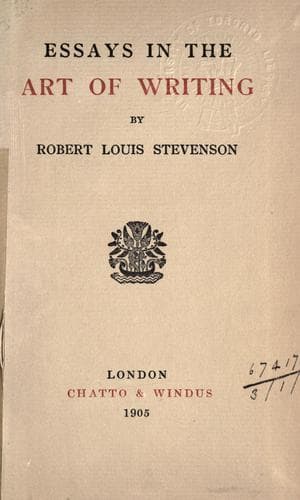
Essays in the Art of WritingStevenson, Robert Louis
History
Essays in the Art of Writing
Stevenson, Robert Louis
Authorship; Literature -- History and criticism; Stevenson, Robert Louis, 1850-1894 -- Authorship
2. _The Web_.—Literature, although it stands apart by reason of the
great destiny and general use of its medium in the affairs of men, is yet
an art like other arts. Of these we may distinguish two great classes:
those arts, like sculpture, painting, acting, which are representative,
or, as used to be said very clumsily, imitative; and those, like
architecture, music, and the dance, which are self-sufficient, and merely
presentative. Each class, in right of this distinction, obeys principles
apart; yet both may claim a common ground of existence, and it may be
said with sufficient justice that the motive and end of any art whatever
is to make a pattern; a pattern, it may be, of colours, of sounds, of
changing attitudes, geometrical figures, or imitative lines; but still a
pattern. That is the plane on which these sisters meet; it is by this
that they are arts; and if it be well they should at times forget their
childish origin, addressing their intelligence to virile tasks, and
performing unconsciously that necessary function of their life, to make a
pattern, it is still imperative that the pattern shall be made.
Music and literature, the two temporal arts, contrive their pattern of
sounds in time; or, in other words, of sounds and pauses. Communication
may be made in broken words, the business of life be carried on with
substantives alone; but that is not what we call literature; and the true
business of the literary artist is to plait or weave his meaning,
involving it around itself; so that each sentence, by successive phrases,
shall first come into a kind of knot, and then, after a moment of
suspended meaning, solve and clear itself. In every properly constructed
sentence there should be observed this knot or hitch; so that (however
delicately) we are led to foresee, to expect, and then to welcome the
successive phrases. The pleasure may be heightened by an element of
surprise, as, very grossly, in the common figure of the antithesis, or,
with much greater subtlety, where an antithesis is first suggested and
then deftly evaded. Each phrase, besides, is to be comely in itself; and
between the implication and the evolution of the sentence there should be
a satisfying equipoise of sound; for nothing more often disappoints the
ear than a sentence solemnly and sonorously prepared, and hastily and
weakly finished. Nor should the balance be too striking and exact, for
the one rule is to be infinitely various; to interest, to disappoint, to
surprise, and yet still to gratify; to be ever changing, as it were, the
stitch, and yet still to give the effect of an ingenious neatness.
Public-domain text, read in full here on John Shaqi.
Reviews
Reviews
No reviews yet
Be the first to share your thoughts on this work.
Join the Discussion
Join the discussion
Sign in to leave a comment or review.
Sign InorCreate an account