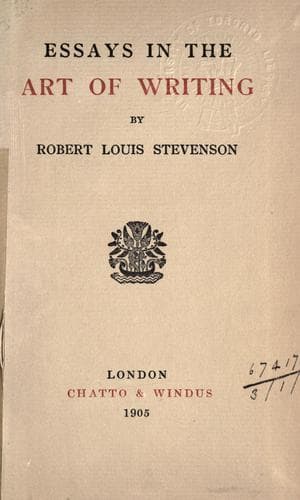
Essays in the Art of WritingStevenson, Robert Louis
History
Essays in the Art of Writing
Stevenson, Robert Louis
Authorship; Literature -- History and criticism; Stevenson, Robert Louis, 1850-1894 -- Authorship
This odd suicide of one branch of the realists may serve to remind us of
the fact which underlies a very dusty conflict of the critics. All
representative art, which can be said to live, is both realistic and
ideal; and the realism about which we quarrel is a matter purely of
externals. It is no especial cultus of nature and veracity, but a mere
whim of veering fashion, that has made us turn our back upon the larger,
more various, and more romantic art of yore. A photographic exactitude
in dialogue is now the exclusive fashion; but even in the ablest hands it
tells us no more—I think it even tells us less—than Molière, wielding his
artificial medium, has told to us and to all time of Alceste or Orgon,
Dorine or Chrysale. The historical novel is forgotten. Yet truth to the
conditions of man’s nature and the conditions of man’s life, the truth of
literary art, is free of the ages. It may be told us in a carpet comedy,
in a novel of adventure, or a fairy tale. The scene may be pitched in
London, on the sea-coast of Bohemia, or away on the mountains of Beulah.
And by an odd and luminous accident, if there is any page of literature
calculated to awake the envy of M. Zola, it must be that _Troilus and
Cressida_ which Shakespeare, in a spasm of unmanly anger with the world,
grafted on the heroic story of the siege of Troy.
This question of realism, let it then be clearly understood, regards not
in the least degree the fundamental truth, but only the technical method,
of a work of art. Be as ideal or as abstract as you please, you will be
none the less veracious; but if you be weak, you run the risk of being
tedious and inexpressive; and if you be very strong and honest, you may
chance upon a masterpiece.
A work of art is first cloudily conceived in the mind; during the period
of gestation it stands more clearly forward from these swaddling mists,
puts on expressive lineaments, and becomes at length that most faultless,
but also, alas! that incommunicable product of the human mind, a
perfected design. On the approach to execution all is changed. The
artist must now step down, don his working clothes, and become the
artisan. He now resolutely commits his airy conception, his delicate
Ariel, to the touch of matter; he must decide, almost in a breath, the
scale, the style, the spirit, and the particularity of execution of his
whole design.
Public-domain text, read in full here on John Shaqi.
Reviews
Reviews
No reviews yet
Be the first to share your thoughts on this work.
Join the Discussion
Join the discussion
Sign in to leave a comment or review.
Sign InorCreate an account