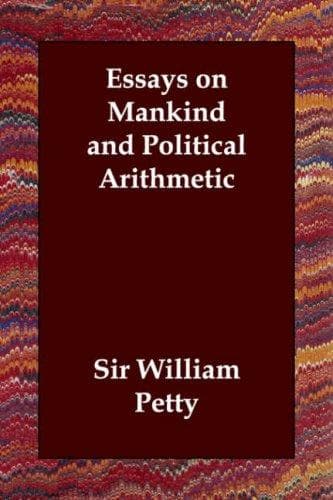
Essays on Mankind and Political Arithmetic — John Shaqi
Essays on Mankind and Political ArithmeticPetty, William, Sir
History
Essays on Mankind and Political Arithmetic
Petty, William, Sir
London (England) -- Population; Population
2. That thirteen parishes are too few for 4,000 families; the middling
parishes of London containing 120 families; according to which rate there
should be about thirty-three parishes in Dublin.
3. It is said that there are 84,000 houses or families in London, which
is twenty-one times more than are in Dublin, and yet the births and
burials of London are but twelve times those of Dublin, which shows that
the inhabitants of Dublin are more crowded and straitened in their
housing than those of London; and consequently that to increase the
buildings of Dublin will make that city more conformable to London.
4. I shall also add some reasons for altering the present forms of the
Dublin bills of mortality, according to what hath been here
recommended—viz.:
1. We give the distinctions of males and females in the births only; for
that the burials must, at one time or another, be in the same proportion
with the births.
2. We do in the weekly and quarterly bills propose that notice be taken
in the burials of what numbers die above sixty and seventy, and what
under sixteen, six, and two years old, foreseeing good uses to be made of
that distinction.
3. We do in the yearly bill reduce the casualties to about twenty-four,
being such as may be discerned by common sense, and without art,
conceiving that more will but perplex and imbroil the account. And in
the quarterly bills we reduce the diseases to three heads—viz.,
contagious, acute, and chronical, applying this distinction to parishes,
in order to know how the different situation, soil, and way of living in
each parish doth dispose men to each of the said three species; and in
the weekly bills we take notice not only of the plague, but of the other
contagious diseases in each parish, that strangers and fearful persons
may thereby know how to dispose of themselves.
4. We mention the number of the people, as the fundamental term in all
our proportions; and without which all the rest will be almost fruitless.
5. We mention the number of marriages made in every quarter, and in
every year, as also the proportion which married persons bear to the
whole, expecting in such observations to read the improvement of the
nation.
6. As for religions, we reduce them to three—viz.: (1) those who have
the Pope of Rome for their head; (2) who are governed by the laws of
their country; (3) those who rely respectively upon their own private
judgments. Now, whether these distinctions should be taken notice of or
not, we do but faintly recommend, seeing many reasons _pro_ and _con_ for
the same; and, therefore, although we have mentioned it as a matter fit
to be considered, yet we humbly leave it to authority.
TWO ESSAYS IN POLITICAL ARITHMETIC,
_Concerning the People_, _Housing_, _Hospitals_, _&c._, _of London and
Paris_.
TO THE KING’S MOST EXCELLENT MAJESTY.
Public-domain text, read in full here on John Shaqi.
Reviews
Reviews
No reviews yet
Be the first to share your thoughts on this work.
Join the Discussion
Join the discussion
Sign in to leave a comment or review.
Sign InorCreate an account