"The common problem, yours, mine, everyone's,
Is--not to fancy what were fair in life
Provided it could be--but, finding first
What may be, then find how to make it fair
Up to our means: a very different thing!
No abstract intellectual plan of life
Quite irrespective of life's plainest laws,
But one, a man, who is man and nothing more,
May lead within a world which (by your leave)
Is Rome or London, not Fool's Paradise."
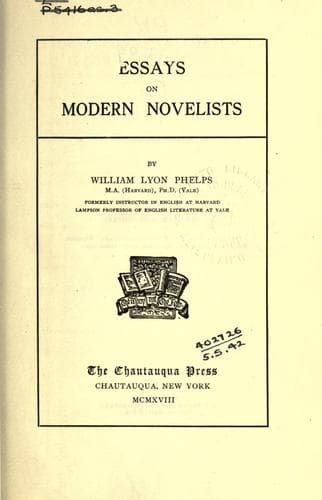
That much of contemporary fiction is worthless, and that the novels
selected should be classics, is a twofold statement, of which the first
phrase is true and the second a _non sequitur_. Much ancient and
mediæval literature read in college is worthless in itself; it is read
because it illustrates the language, or represents some literary form,
or because it throws light on the customs and ideas of the time. The
fact that a certain obscure work was written in the year 1200 does not
necessarily prove that it is more valuable for study than one written in
1909. Now it so happens that the modern novel has become more and more
the mirror of modern ideas; and for a student who really wishes to know
what people are thinking about all over the world to-day, the novels of
Tolstoi, Björnson, Sudermann, and Thomas Hardy cannot wisely be
neglected. Why should the study of the contemporary novel and the
contemporary drama be tabooed when in other departments of research the
aim is to be as contemporary as possible? We have courses in social
conditions that actually investigate slums. I am not for a moment
pleading that the study of modern novels and modern art should supplant
the study of immortal masterpieces; but merely that they should have
their rightful place, and not be regarded either with contempt or as
unworthy of serious treatment. The two most beneficial ways to study a
novel are to regard it, first, as an art-form, and secondly as a
manifestation of intellectual life; from neither point of view should
the contemporary novel be wholly neglected.
That many of the novels of to-day are immoral is true, but it is still
more true of the classics. The proportion of really immoral books to the
total production is probably less to-day than it ever was before; in
fact, there are an immense number of excellent contemporary novels which
are spotless, something that cannot be said of the classics of antiquity
or of the great majority of literary works published prior to the
nineteenth century. If immorality be the cry, what shall we say about
Aristophanes or Ovid? How does the case stand with the comedies of
Dryden or with the novels of Henry Fielding? No, it is undoubtedly true
that the teacher who handles modern fiction can more easily find a
combination of literary excellence and purity of tone than he could in
any previous age.
Public-domain text, read in full here on John Shaqi.
Reviews
Reviews
No reviews yet
Be the first to share your thoughts on this work.
Elsewhere in the archive
Join the Discussion
Join the discussion
Sign in to leave a comment or review.
Sign InorCreate an account