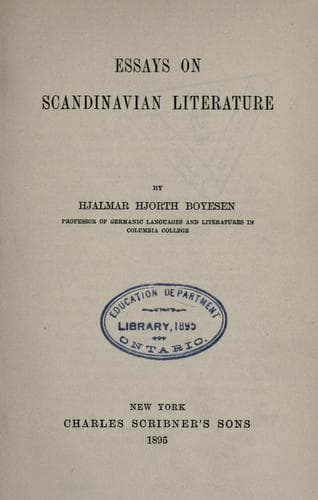
Essays on Scandinavian LiteratureBoyesen, Hjalmar Hjorth
History
Essays on Scandinavian Literature
Boyesen, Hjalmar Hjorth
Authors, Scandinavian; Scandinavian literature -- History and criticism
The late Romantic authors of Denmark who lived on the traditions of
Oehlenschlaeger's time and the aesthetical doctrines of J. L. Heiberg,
have gradually been passing away; and a new generation has grown up,
which, though it knows Joseph, has repudiated his doctrine. A period of
stagnation followed the disappearance of the Romanticists. The
Sleswick-Holstein war of 1866, and the consequent hostility to Germany,
cut off the intellectual intercourse between the two countries which in
the first half of the century had been lively and intimate; and as, for
a while, no new ties were formed, a respectable dulness settled upon the
little island kingdom. People lived for the concerns of the day, earned
their bread and butter, amused themselves to the best of their ability,
but troubled themselves very little about the battles of thought which
were being fought upon the great arena of the world. The literary
activity which now and then flared up spasmodically, like flames over a
smouldering ash-heap, flickered and half-expired for want of fresh
sustenance. A direfully conventional romanticist, H. F. Ewald
(1821-1892), wrote voluminous modern and historical novels, the heroines
of which were usually models of all the copy-book virtues, and the
heroes as bloodless as their brave and loyal prototypes in "Ivanhoe" and
"Waverley." Instead of individualizing his _dramatis personae_ this
feeble successor of Ingemann and Walter Scott gave them a certificate of
character, vouching for their goodness or badness, and trusting the
reader to take his word for it in either case. Like many another popular
novelist, he varnished them with the particular tint of excellence or
depravity that might suit his purpose, stuffed their heads with bran and
their bellies with sawdust, but troubled himself little about what lay
beneath the epidermis. There was something _naive_ and juvenile in his
view of life which appealed to the large mass of half-educated people;
and the very absence of any subtle literary art tended further to
increase his public. Many of his books, notably "The Youth of Valdemar
Krone" (_Valdemar Krone's Ungdomshistorie_), "The Swedes at Kronborg"
(_Svenskerne paa Kronborg_), have achieved an extraordinary success. The
former deals with contemporary life, while the latter expurgates and
embellishes history after the manner of Walter Scott. Two subsequent
novels, "The Family Nordby" and "Johannes Falk," are, like all of
Ewald's writings, pervaded by a robust optimism and a warm Danish
sentiment, which in a large measure account for their popularity with
the public of the circulating libraries.
Public-domain text, read in full here on John Shaqi.
Reviews
Reviews
No reviews yet
Be the first to share your thoughts on this work.
Elsewhere in the archive
Join the Discussion
Join the discussion
Sign in to leave a comment or review.
Sign InorCreate an account