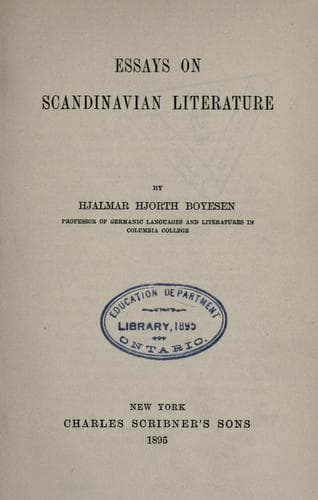
Essays on Scandinavian LiteratureBoyesen, Hjalmar Hjorth
History
Essays on Scandinavian Literature
Boyesen, Hjalmar Hjorth
Authors, Scandinavian; Scandinavian literature -- History and criticism
A lesser share of the same kind of popularity has fallen to the lot of
an author of a much higher order--Wilhelm Bergsoee (born 1835). His
voluminous novel "Fra Piazza del Popolo" (1860) made a sensation in its
day, and "From the Old Factory" (1869), which constructively is a
maturer book, is likewise full of fascination. The description of the
doings of the artistic guild in Rome, which occupies a considerable
portion of the former work, is delightful, though intermingled with a
deal of superfluous mysticism and romantic entanglements which were then
held to be absolutely indispensable. "In the Sabine Mountains" (1871),
the scene of which is laid in Genazzano during the struggle for Italian
independence, is a trifle too prolix; and its effect is lessened by the
old-fashioned epistolary form. Signor Carnevale, the revolutionary
apothecary, is, however, a very amusing figure, and would be still
better if he were not caricatured. The tendency to screw the characters
up above the normal--to tune them up to concert pitch as it
were--interferes seriously with the pleasure which the book otherwise
might yield.
The conception of art as something wholly distinct from and above nature
animates all Bergsoee's productions. The theory of fiction which R. L.
Stevenson has so eloquently propounded has found an able practitioner in
him. For all that, I am indebted to Bergsoee's two Italian romances for
a great deal of enjoyment, the afterglow of which still warms my memory.
But that was long ago. A young man is apt to enjoy in a book quite as
much what he himself supplies as that which the author has deposited
therein. Each word is a key which unlocks a store of imprisoned
emotions. The very word Italy has a magic which imparts to it a charm
even in the geography. And Bergsoee, though he works, without suspicion
of its decrepitude, the ancient machinery of Italian romance, is
unaffectedly eloquent and unsophistically entertaining. The historic
whisperings which he catches from the names, the ruins, the facial
types, and the very trees and grass of Genazzano invest his letters from
that picturesque neighborhood with a certain beautiful glow of color and
a dusky richness of decay. The autobiographical form imposes, to be
sure, an increasing strain on the reader's credulity, as the plot
thickens, and we find ourselves, half-unexpectedly, involved in a lurid
tale of monks, priests, disguised revolutionists, cruel, mercenary
fathers, etc., and the Danish author playing his favorite _role_ of
_deus ex machina_. Still more incredible is the part of benevolent
Providence which he assigns to himself in "The Bride of Roervig," where
he saves the heroine's life by restoring to her a ring given to her
lover, and thus assuring her that he is alive when she believes him
dead. The autobiographical story (especially when the writer is a mere
convenient supernumerary, designed, like the uncle from America in the
Public-domain text, read in full here on John Shaqi.
Reviews
Reviews
No reviews yet
Be the first to share your thoughts on this work.
Elsewhere in the archive
Join the Discussion
Join the discussion
Sign in to leave a comment or review.
Sign InorCreate an account