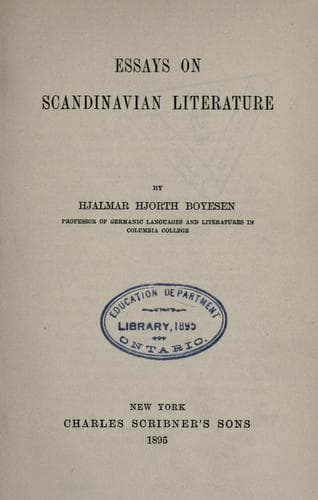
Essays on Scandinavian LiteratureBoyesen, Hjalmar Hjorth
History
Essays on Scandinavian Literature
Boyesen, Hjalmar Hjorth
Authors, Scandinavian; Scandinavian literature -- History and criticism
The three next books of Brandes, which all deal with aesthetical subjects
("AEsthetic Studies," 1868, "Criticisms and Portraits," 1870, and "French
AEsthetics at the Present Day"), are full of pith and winged felicities
of phrase. It is a delight to read them. The passage of Scripture often
occurs to me when I take up these earlier works of Brandes: "He
rejoiceth like a strong man to run a race." He handles language with the
zest and vigor of conscious mastery. There is no shade of meaning which
is so subtle as to elude his grip. Things which I should have said, _a
priori_, were impossible to express in Danish he expresses with scarcely
a sign of effort; and however new and surprising his phrase is, it is
never awkward, never cumbrous, never apparently conscious of its
brilliancy.
I do not mean to say that these linguistic excellences are
characteristic only of Dr. Brandes's earlier works; but, either because
he has accustomed us to expect much of him in this respect, or because
he has come to regard such brilliancy as of minor consequence, it is a
fact that two of his latest hooks ("Impressions of Poland" and
"Impressions of Russia") contain fewer memorable phrases, fewer winged
words, fewer _mots_ with a flavor of Gallic wit. Intellectually these
"Impressions" are no less weighty; nay, they are more weighty than
anything from the same pen that has preceded them. They show a faculty
to enter sympathetically into an alien civilization, to seize upon its
characteristic phases, to steal into its confidence, as it were, and
coax from it its intimate secrets; and they exhibit, moreover, an
acuteness of observation and an appreciation of significant trifles (or
what to a superficial observer might appear trifles) which no previous
work on the Slavonic nations had displayed. It is obvious that Dr.
Brandes here shuns the linguistic pyrotechnics in which, for instance,
De Amicis indulges in his pictures of Holland and the Orient. It is the
matter, rather than the manner, which he has at heart; and he apparently
takes a curb bit between his teeth in the presence of the Kremlin of
Moscow and the palaces of St. Petersburg, in order to restrain mere
pictorial expression.
Having violated chronology in speaking of these two works out of their
order, I shall have to leap back over a score of years and contemplate
once more the young doctor of philosophy who returned to Copenhagen in
1872 and began a course of trial lectures at the University on modern
literature. The lecturer here flies his agnostic colors from beginning
to end. He treats "The Romantic School in Germany" as Voltaire treated
Rousseau--with sovereign wit, superior intelligence, but scant sympathy.
At the same time he penetrates to the fountains of life which infused
strength into the movement. He accounts for romanticism as the chairman
of a committee _de lunatico inquirendo_ might account for a case of
religious mania.
Public-domain text, read in full here on John Shaqi.
Reviews
Reviews
No reviews yet
Be the first to share your thoughts on this work.
Elsewhere in the archive
Join the Discussion
Join the discussion
Sign in to leave a comment or review.
Sign InorCreate an account