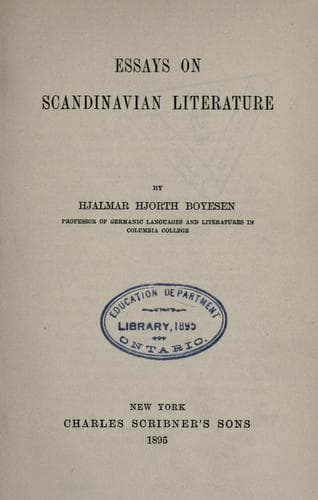
Essays on Scandinavian LiteratureBoyesen, Hjalmar Hjorth
History
Essays on Scandinavian Literature
Boyesen, Hjalmar Hjorth
Authors, Scandinavian; Scandinavian literature -- History and criticism
The prophetic vagueness of this paragraph, big with dim possibilities,
conveys the very impression to which all observations and experiences in
Russia finally reduce themselves. It is the enduring residue which
remains when all evanescent impressions have lapsed into the background.
It expresses, too, the typical mental attitude of every Russian, be he
ever so Frenchified and denationalized. The word "Virgin Soil" was a
favorite phrase with Tourgueneff when speaking of his country, and he
used it as the title of his last novel. It seemed to him to explain
everything in Russian conditions that to the rest of the world appeared
enigmatical. The whole of Dr. Brandes's book is interpenetrated with
this consciousness of the vast possibilities hidden in the virgin bosom
of the new earth, even though they may be too deeply hidden to sprout up
into the daylight for centuries to come. The Russian literature, which
is at present enchaining the attention of the civilized world, is a
brilliant variation of this theme, an imaginative commentary on this
text. The second half of Dr. Brandes's "Impressions" is devoted to the
consideration of Puschkin, Gogol, Lermontoff, Dostojevski, Tourgueneff,
and Tolstoi; of each of whom he gives, as it appears to me, a better
account than M. de Voguee in his book "Le Roman Russe," which gave him a
seat among the Forty Immortals.
The significance of Dr. Brandes's literary activity, which has now
extended over a quarter of a century, can hardly be estimated from our
side of the Atlantic. The Danish horizon was, twenty years ago, hedged
in on all sides by a patriotic prejudice which allowed few foreign ideas
to enter. As previously stated, the people had, before the two
Sleswick-Holstein wars, been in lively communication with Germany, and
the intellectual currents of the Fatherland had found their way up to
the Belts, and had pulsated there, though with some loss of vigor. But
the disastrous defeat in the last war aroused such hostility to Germany
that the intellectual intercourse almost ceased. German ideas became
scarcely less obnoxious than German bayonets. Spiritual stagnation was
the result. For no nation can with impunity cut itself off from the
great life of the world. New connections might, perhaps, have been
formed with France or England; but the obstacles in the way of such
connections appeared too great to be readily overcome. Racial
differences and consequent alienism in habits of thought made a
_rapprochement_ seem hopeless. It seemed, for awhile, as if the war had
cut down the intellectual territory of the Danes even more than it had
curtailed their material area. They cultivated their little domestic
virtues, talked enthusiastic nonsense on festive occasions, indulged in
vain hopes of recovering their lost provinces, but rarely allowed their
political reverses to interfere with their amusements. They let the
world roar on past their gates, without troubling themselves much as to
Public-domain text, read in full here on John Shaqi.
Reviews
Reviews
No reviews yet
Be the first to share your thoughts on this work.
Elsewhere in the archive
Join the Discussion
Join the discussion
Sign in to leave a comment or review.
Sign InorCreate an account