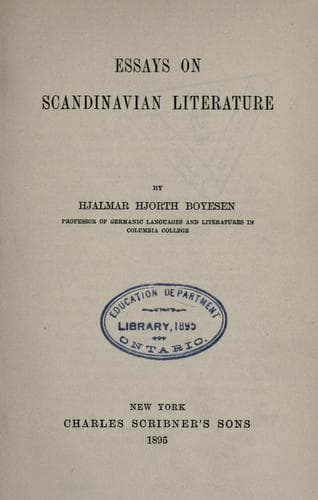
Essays on Scandinavian LiteratureBoyesen, Hjalmar Hjorth
History
Essays on Scandinavian Literature
Boyesen, Hjalmar Hjorth
Authors, Scandinavian; Scandinavian literature -- History and criticism
what interested or agitated it. A feeble, moonshiny late-romanticism was
predominant in their literature; and in art, philosophy, and politics
that sluggish conservatism which betokens a low vitality, incident upon
intellectual isolation.
What was needed at such a time was a man who could re-attach the broken
connection--a mediator and interpreter of foreign thought in such a form
as to appeal to the Danish temperament and be capable of assimilation by
the Danish intellect. Such a man was Georg Brandes. He undertook to put
his people _en rapport_ with the nineteenth century, to open new avenues
for the influx of modern thought, to take the place of those which had
been closed. We have seen that he interpreted to his countrymen the
significance of the literary and social movements both in England and in
France. But a self-satisfied and virtuous little nation which regards
its remoteness from the great world as a matter of congratulation is not
apt to receive with favor such a champion of alien ideas. The more the
Danes became absorbed in their national hallucinations, the more
provincial, nay parochial, they became in their interests, the less did
they feel the need of any intellectual stimulus from abroad; and when
Dr. Brandes introduced them to modern realism, agnosticism, and
positivism they thanked God that none of these dreadful isms were
indigenous with them; and were disposed to take Dr. Brandes to task for
disturbing their idyllic, orthodox peace by the promulgation of such
dangerous heresies. When the time came to fill the professorship for
which he was a candidate, he was passed by, and a safer but inferior man
was appointed. A formal crusade was opened against him, and he was made
the object of savage and bitter attacks. I am not positive, but am
disposed to believe, that it was this crusade, not against his opinions
only, but against the man himself, which drove Dr. Brandes from
Copenhagen, and induced him, in October, 1877, to settle in Berlin. Here
he continued his literary activity with unabated zeal, became a valued
contributor to the most authoritative German periodicals, and gained a
conspicuous position among German men of letters. But while he was
sojourning abroad, the seed of ideas which he had left at home began to
sprout, and in 1882 his friends in Copenhagen felt themselves strong
enough to brave the antagonism which his aesthetical and religious
heresies had aroused. At their invitation he returned to Denmark, having
been guaranteed an income of four thousand crowns ($1,000) for ten
years, with the single stipulation that he should deliver an annual
course of public lectures in Copenhagen. Since then his reputation has
spread rapidly throughout the civilized world; his books have been
translated into many languages, and he would have won his way to a
recognition, as the foremost of contemporary critics, if he had not in
his later publications discredited himself by his open sympathy with
anarchism.
Public-domain text, read in full here on John Shaqi.
Reviews
Reviews
No reviews yet
Be the first to share your thoughts on this work.
Elsewhere in the archive
Join the Discussion
Join the discussion
Sign in to leave a comment or review.
Sign InorCreate an account