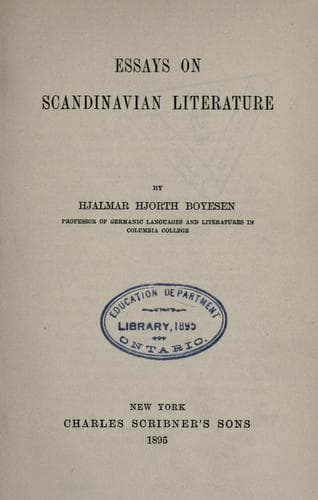
Essays on Scandinavian LiteratureBoyesen, Hjalmar Hjorth
History
Essays on Scandinavian Literature
Boyesen, Hjalmar Hjorth
Authors, Scandinavian; Scandinavian literature -- History and criticism
but torpedoes of his making would scarcely do the ark much harm. They
have not the explosive power of Ibsen's. There are in every age men who,
unable to achieve the fame of Dinocrates, who built the temple of the
Ephesian Diana, aspire to that of Herostratos, who destroyed it. To
admire these men is as compromising as to be admired by them.
In the essay on "Martin Luther on Celibacy and Marriage" Dr. Brandes
derides with a satyr-like leer all traditional ideas of chastity,
conjugal fidelity, and marital honor.
Though he pretends to fight behind Luther's shield the deftest thrusts
are not the reformer's, but the essayist's own. Fundamentally, I fancy,
this is an outbreak of that artistic paganism which is so prevalent
among the so-called "advanced" Hebrews. The idea that obedience to law
is degrading; that conformity to traditional morals is soul-crippling
and unworthy of a free spirit; that only by giving sway to passion will
the individual attain that joy which is his right, and that
self-development which should be his highest aim, has found one of its
ablest and most dangerous advocates in Georg Brandes.
ESAIAS TEGNER
The genius of the Scandinavian north has never found a more complete and
brilliant incarnation than the Swedish poet Esaias Tegner. Strong,
cheerful, thoroughly wholesome, with a boyish delight in prowess,
adventure, and daring deeds, he presents a most agreeable contrast to
the moonshine singers and graveyard bards of the phosphoristic school,
who were his contemporaries. To Tegner, in his prime, life was a brisk
and exhilarating sail, with a fresh breeze, over sunny waters; and he
had no patience with those who described it as a painful and troublous
groping through the valley of the shadow of death. There was, in other
words, a certain charming juvenility in his attitude toward existence,
which presented to him no riddles that a man with a strong arm and an
honest heart might not solve with comparative ease. All problems were to
him soluble with the sword; and Alexander, when he cut the Gordian knot,
must have appeared to him wiser, as he was surely more admirable, than
either Plato or Socrates. This scorn of all metaphysical subtleties, and
reliance upon strength and Swedish manhood, are, perhaps (from an
advanced European point of view), indicative of a little intellectual
immaturity; but they are thoroughly characteristic of the Scandinavian
nationalities. The love of brave words and brave deeds, the exaltation
of the man of action above the man of thought, the pleasure in reckless
gallantry and foolhardy adventure, are, however, not confined to Swedes
and Norwegians, but are characteristic of the boyhood of every nation.
In the Scotchman, Robert Louis Stevenson, this jaunty juvenility, this
rich enjoyment of bloody buccaneers and profane sea-dogs, is carried to
far greater lengths, and the great juvenile public of England and
America, both young and old, rises up and calls him blessed.
Public-domain text, read in full here on John Shaqi.
Reviews
Reviews
No reviews yet
Be the first to share your thoughts on this work.
Elsewhere in the archive
Join the Discussion
Join the discussion
Sign in to leave a comment or review.
Sign InorCreate an account