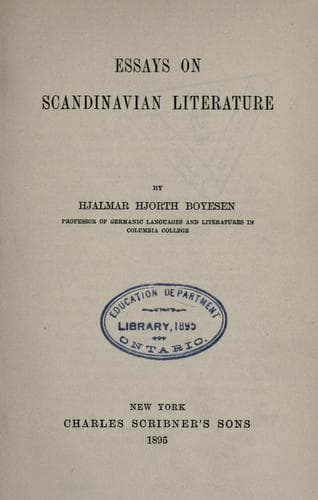
Essays on Scandinavian LiteratureBoyesen, Hjalmar Hjorth
History
Essays on Scandinavian Literature
Boyesen, Hjalmar Hjorth
Authors, Scandinavian; Scandinavian literature -- History and criticism
In order to substantiate this it is only necessary to call attention to
the fifth volume of his lectures entitled "Young Germany" (_Det unge
Tydskland_, 1890), which betrays extraordinary intellectual acumen but
also a singular confusion of moral values. All revolt is lauded, all
conformity derided. The former is noble, daring, Titanic; the latter is
pusillanimous and weak. Conjugal irregularities are treated not with
tolerance but with obvious approval. Those authors who dared be a law
unto themselves are, by implication at least, praised for flinging down
their gauntlets to the dull, moral Philistines who have shackled
themselves with their own stupid traditions. That is the tone of
Brandes's comment upon such relations as that of Immermann to Eliza von
Luetzow.
But nowhere has he unmasked so Mephistophelian a countenance as in his
essays on Luther and on an obscure German iconoclast named Friedrich
Nietschke (_Essays: Fremmede Personligheder_, pp. 151-244). It is
difficult to understand how a man of well-balanced brain and a logical
equipment second to none, can take _au serieux_ a mere philosophical
savage who dances a war-dance amid what he conceives to be the ruins of
civilization, swings a reckless tomahawk and knocks down everybody and
everything that comes in his way. There must lie a long history of
disappointment and bitterness behind that endorsement of anarchy pure
and simple. And it is the sadder to contemplate because it casts a
sinister light upon Dr. Brandes's earlier activity and compels many an
admirer of his literary art to revise his previous opinion of him. Can a
man ever have been a sound thinker who at fifty practically hoists the
standard of anarchy? A ship is scarcely to be trusted that flies such
compromising colors.
That all development, in order to be rational, must have its roots in
the past--must be in the nature of a slow organic growth--is certainly a
fundamental proposition of the Spencerian sociology. It is the more to
be wondered at that an evolutionist like Dr. Brandes, in his impatience
at the tardiness of social progress, should lose his philosophic temper
and make common cause with a crack-brained visionary. The kind of
explosive radicalism which Nietschke betrays in his cynical questions
and explanations is no evidence of profundity or sagacity, but is the
equivalent of the dynamiter's activity, transferred to the world of
thought. His pretended re-investigation of the foundations of the moral
sentiments reminds one of the mud geysers of the Yellowstone, which
break out periodically and envelop everything within reach in an
indeterminate shower of mud. To me there is more of vanity than of
philosophic acumen in his onslaught on well-nigh all human institutions.
He would, like Ibsen, no doubt,
"Place 'neath the ark the torpedo most cheerfully;"
Public-domain text, read in full here on John Shaqi.
Reviews
Reviews
No reviews yet
Be the first to share your thoughts on this work.
Elsewhere in the archive
Join the Discussion
Join the discussion
Sign in to leave a comment or review.
Sign InorCreate an account