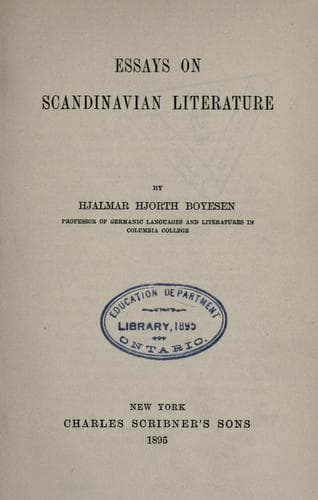
Essays on Scandinavian LiteratureBoyesen, Hjalmar Hjorth
History
Essays on Scandinavian Literature
Boyesen, Hjalmar Hjorth
Authors, Scandinavian; Scandinavian literature -- History and criticism
Having this conception of the episcopal office, he could not escape
emphasizing his function as the supervisor of the schools of his
diocese. If he was to be a civilizer on any great scale, the chance
which was here afforded him to impress his ideals upon the rising
generation was not one to be neglected. And, as a matter of fact, Tegner
was indefatigable in his labors as an educator. His many speeches at
school celebrations preached, as ever, a gospel derived from Greece
rather than Judaea; and half-improvised though some of them appear to be,
they contain passages of lofty eloquence.
It was inevitable that a bishop of such commanding personality, who
wielded his authority at times somewhat ruthlessly, should make enemies.
But, on the other hand, the beautiful beneficence and sincere humanity
of the man often obliterated the ill-feeling which his official severity
had aroused. To the widows of deceased clergymen in his diocese he was a
veritable guardian, to their children a father, to his peasantry a
friend, adviser, and monitor. He was an expert at detecting errors in
ecclesiastical balance-sheets; and woe to the cleric who dared present
to him inaccurate accounts of income and expenditures. By sheer dint of
his personal superiority and that quality of soul which George Eliot
calls dynamic, he impressed himself strongly upon all with whom he came
in contact; and though he was feared, he was also beloved as few. A very
delightful instance of the reverence with which he was regarded is
recorded by Boettiger.
One summer evening he arrived at a remote parsonage which had never, in
the memory of man, been visited by a bishop. Some time after his arrival
Tegner observed two young ladies, the daughters of the house, coming
across the yard carrying between them a big tub, full of water. When he
asked them, in a friendly way, why they subjected themselves to such
hard labor, one of them replied: "Should we not regard it as an honor to
be allowed to water the bishop's horses?"
In order to give a clear and coherent idea of Tegner in his prime, I
have been obliged to anticipate events. Many literary achievements which
I have left unrecorded belong to the period previous to his assumption
of the bishopric of Wexioe. Unhappily Professor Boettiger's edition is
very chary of dates, and as Dr. Brandes has truly observed, is arranged
with the obvious purpose of falsifying the sequence of Tegner's poems
and confusing the reader. The three periods--previous to 1812, 1812-40,
and 1840-46--are entirely arbitrary, and plainly devised with a view to
concealing, in so far as they are capable of concealment, the unhappy
events which undermined the strength of the Titan and wrecked his
splendid powers. But such a purpose is utterly futile, as long as the
poems themselves had once escaped into publicity.
Public-domain text, read in full here on John Shaqi.
Reviews
Reviews
No reviews yet
Be the first to share your thoughts on this work.
Elsewhere in the archive
Join the Discussion
Join the discussion
Sign in to leave a comment or review.
Sign InorCreate an account