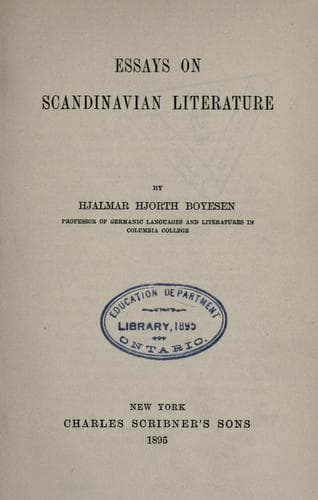
Essays on Scandinavian LiteratureBoyesen, Hjalmar Hjorth
History
Essays on Scandinavian Literature
Boyesen, Hjalmar Hjorth
Authors, Scandinavian; Scandinavian literature -- History and criticism
It was during the period while his sky was yet unclouded that Tegner
enriched Swedish literature with a series of lyrics which in point of
lucidity of thought and brilliancy of diction have rarely been
surpassed. It may be admitted, without materially detracting from his
merit, that in some of them the foreign models from which they were in a
measure fashioned shimmer through. Just as the Germans, Gottsched and
Bodmer, held foreign models to be indispensable, and only disagreed as
to which were the best, so the Swedish Academy, which in its
predilections was French, had no scruple in recommending this or that
literary form for imitation. That degree of literary independence which
Germany reached with Goethe and Schiller, who discarded all models, the
Scandinavian countries did not reach until a much later period; and
Tegner was one of those who stimulated that national self-respect
without which independence is impossible.
A strong spiritual kinship drew him to Schiller, whose splendor of
imagery and impassioned rhetoric were the very gifts which he himself in
a superlative degree possessed. The breath of political and religious
liberalism which pervades the writings of the German poet was also
highly congenial to Tegner, and last, but not least, they were both
light-loving, beauty-worshipping Hellenists, and, though externally
conformists, hid joyous pagan souls under imperfect Christian draperies.
Small blame it is therefore to Tegner that Schiller's poems furnished
him with frequent suggestions and sometimes also with metres. Schiller
had, in "The Gods of Greece," sung a glorious elegy on the Olympian age
which stimulated his Swedish rival to write "The Asa Age," in which he
regretted, though in a rather half-hearted way, the disappearance of
Odin, Thor, and Freya. The poem, it must be admitted, falls much below
Tegner at his best. Schiller's "Three Words of Faith," in which liberty,
virtue, and God are declared to be the only essentials of religion,
finds a parallel (which even retains the metre) in Tegner's "The
Eternal," in which truth, justice, and beauty are substituted. A kindred
poetic creed is far more consciously proclaimed in the famous poem
_Sangen_ (Poetry), which was primarily a protest against the gloomy and
morbid view of poetry entertained by the Swedish Romanticists (the
so-called Phosphorists). Tegner here declares that the poet "with
heavenly joy embraces life," that "he knows no weak lament" (at its
misery), "no dissonance which is not dissolved" (in harmony). His temple
stands in light and flame; and at its base a fountain gurgles, a draught
from which is an elixir of strength and a panacea for all ills.
"Well, then," he continues, "from this fountain will I drink, if I am
worthy of such a draught. With healthy eyes will I look about me in the
sick world. My golden lyre shall not resound with sorrows which I myself
have invented. For the poet's sorrows are none; and the sky of song is
forever bright."
Public-domain text, read in full here on John Shaqi.
Reviews
Reviews
No reviews yet
Be the first to share your thoughts on this work.
Elsewhere in the archive
Join the Discussion
Join the discussion
Sign in to leave a comment or review.
Sign InorCreate an account