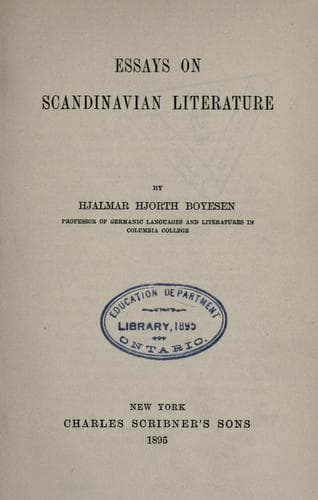
Essays on Scandinavian LiteratureBoyesen, Hjalmar Hjorth
History
Essays on Scandinavian Literature
Boyesen, Hjalmar Hjorth
Authors, Scandinavian; Scandinavian literature -- History and criticism
This is exactly the Byronic note, which would be still more audible, if
I had preserved the rhymed couplets. Even Medora's male attire is
borrowed by Maria, and much more of this Byronic melodramatic heroism is
there, only a little more conventionally draped and with larger
concessions to the Philistine sense of propriety. But even if Tegner in
"Axel" had coquetted with the Romantic muse, it would be rash to
conclude that he contemplated any durable relation. The note which he
had struck in his renowned oration at the festival commemorating the
Reformation (1817), came from the depth of his heart, and continued to
resound through his speech and song for many years to come. I do not
moan to imply, of course, that the Byronic Romanticism was very closely
akin to that of Tieck, the Schlegels, and Novalis; or that Tegner in the
least compromised his frank and manly liberalism by composing a
variation, as it were, on a Byronic theme. How deeply he hated the
mediaeval obscurantism which then, under the auspices of Metternich and
his unholy "Holy Alliance" was spreading over Europe, he showed in
numerous private and public utterances concerning the political
condition of Europe after the fall of Napoleon. His greeting to the "New
Year, 1816" (which his son-in-law has foolishly excluded from his
edition of the collected works), is overbrimming with bitterness at the
triumph of the enemies of the light.
"Hurrah! Religion is a Jesuit,
The rights of man are Jacobins;
The world is free; the raven is white;
Long live the Pope--and that other;
I am going to Germany, and there I'll learn
Sonnets to sing and incense to burn.
"Welcome, thou New Year, with murder and gloom,
Stupidity, lies, and fraud!
I hope thou'lt make an end of our earth,
A bullet at least she's worth;
She's restless, poor thing, like many another,
A shot through the head--she'll cause no more bother!"
It was the fashion in those days to revile the Revolution, because it
had produced the man on horseback who had turned the old order of things
topsy-turvy in a very unceremonious fashion. Coleridge, Southey, and
Wordsworth in England, and Klopstock, Schiller, and a horde of lesser
lights in Germany, had hailed the French uprising as the bloody dawn of
a new and more glorious day; but the excesses of the Reign of Terror
frightened them back into the old fastnesses of Conservatism. Tegner
(and to his honor be it said) was one of the few who did not despair of
liberty because a people born and bred in despotism failed to exercise
the wisdom and self-restraint which only liberty can foster. For the
only road to the attainment of liberty is its practice and its abuse,
and the slow education which can be acquired by no theoretical teaching,
but only in the hard and expensive school of experience. For the
terrible birth-pangs of liberty no despotically governed people can
escape, unless it chooses to remain in thraldom.
Public-domain text, read in full here on John Shaqi.
Reviews
Reviews
No reviews yet
Be the first to share your thoughts on this work.
Elsewhere in the archive
Join the Discussion
Join the discussion
Sign in to leave a comment or review.
Sign InorCreate an account