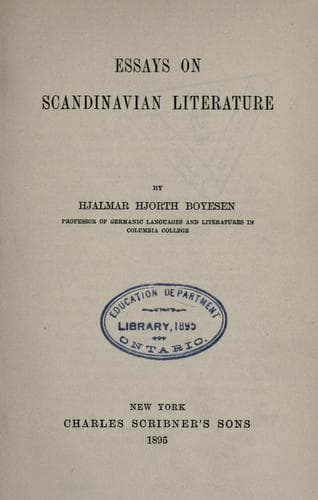
Essays on Scandinavian LiteratureBoyesen, Hjalmar Hjorth
History
Essays on Scandinavian Literature
Boyesen, Hjalmar Hjorth
Authors, Scandinavian; Scandinavian literature -- History and criticism
This is all very magnificent; but the images tread so close upon each
other's heels, that they come near treading each other down, and
tumbling together in a confused jumble. I claim no originality in
calling attention to the fact that it must have been a colossal Naiad
who could wear the evening glow like "a gorgeous rose upon her breast."
Likewise former critics have questioned whether the stars gain in the
least in vividness by being compared to the priests of Egypt,[31] who
were certainly far less familiar to the reader's vision.
[31] L. Dietrichson: Indledning i Studiet af Sveriges Litteratur.
Kjoebenhavn, 1862. See also Svensk Litteratur-Tidning as quoted in B.
E. Malmstroem: Grunddragen af Svenska Vitterhetens Historia, vol. v.,
p. 423. Oerebro.
The story of the Swedish officer Axel and his beloved, the Cossack
Amazon, Maria, has from beginning to end a flavor of Byron, and recalls
alternately "the Corsair" and "Lara." The extravagant sentimentality of
the tale appealed, however, powerfully to the contemporary taste, and
the dissenting voice of criticism was drowned like the shrill note of a
single fife in the noisy orchestra of praise. The Swedish matrons and
maidens wept over Axel's and Maria's heroic, but tragic love, as those
of England, nay, of all Europe, wept over that of Conrad and Medora.
Maria, when she hears that Axel has a betrothed at home, enlists as a
man in the Russian army (a very odd proceeding by the way, and scarcely
conducive to her purpose) and resolves to kill her rival. She is,
however, mortally wounded, and Axel finds her dying upon the
battlefield.
"Yea, it was she; with smothered pain
She whispers with a voice full faint:
'Good-evening, Axel, nay, good-night,
For death is nestling at my heart.
Oh! ask not what hath brought me hither;
'Twas love alone led me astray.
Alas! the last long night is dusking;
I stand before the grave's dread door.
How different life, with all its small distresses,
Seems now from what it seemed of yore!
And only love--love fair as ours,
Can I take with me to the skies.'"[32]
[32] The original is in the rhymed Byronic metre, mostly in
couplets. In order not to sacrifice anything of the meaning I have
chosen to put it into blank verse.
Public-domain text, read in full here on John Shaqi.
Reviews
Reviews
No reviews yet
Be the first to share your thoughts on this work.
Elsewhere in the archive
Join the Discussion
Join the discussion
Sign in to leave a comment or review.
Sign InorCreate an account