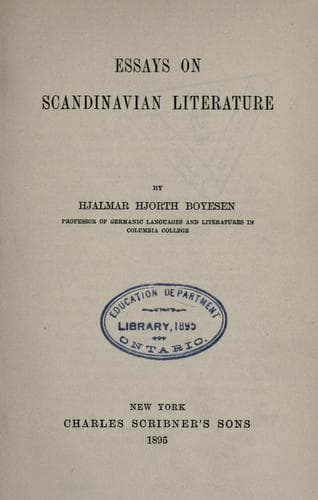
Essays on Scandinavian LiteratureBoyesen, Hjalmar Hjorth
History
Essays on Scandinavian Literature
Boyesen, Hjalmar Hjorth
Authors, Scandinavian; Scandinavian literature -- History and criticism
"In vain they call upon the lofty Truth
With sombre conjurations; for the dark
She ne'er endures; for her abode is light.
In Phoebus' world, in knowledge as in song,
All things are bright. Bright beams the radiant sun;
Clear runs and pure his bright Castalian fountain.
Whate'er thou canst not clearly say thou know'st not.
Twin-born with thought is word on lips of man;
That which is darkly said is darkly thought;
For wisdom true is like the diamond,
A drop that's petrified of heavenly light;
The purer that it is, the more its value,
The more the daylight shines and glitters through it.
The ancients builded unto Truth a temple,
A fair rotunda, light as heaven's vault.
And freely poured the sunshine from all sides
Into its open round; the winds of heaven
Amid its ranks of pillars gayly gambolled.
But now instead we build a Tower of Babel,
A heavy, barbarous structure. Darkness peeps
From out its deep and narrow grated casements.
Unto the sky the tower was meant to reach,
But hitherto we've only had confusion.
As in the realm of thought, in that of song
It is; and poesy is e'er transparent ..."
[36] A magister promotion corresponds approximately to our
university commencements. It is the ceremony of bestowing the degree
of master of arts.
This was certainly an attractive doctrine, and it did not fail to
command public approval. But it suffers from exactly the same limitation
as Tegner's gospel of joy. It is only relatively (I might almost say
temperamentally) true; and the opposite might be maintained with equal
force, and in fact was so maintained by Atterbom, who declared (in the
"Poetical Calendar for 1821") that there can be no such a conception as
light without darkness. Darkness, he says, is the condition of all color
and form. You distinguish the light and all things in it only by the
contrasting effect of shadow--all of which, I fancy, Tegner would not
have denied. More to the point would have been the query whether in
poetry darkness and indistinctness are synonymous terms. It is only the
most commonplace truths which can be made intelligible to all. Much of
the best and highest thinking of humanity lies above the plane of the
ordinary untrained intellect. What is light to me may be twilight or
darkness to you. What to you is clear as the daylight, may to me be as
densely impenetrable as the Cimmerian night. Christ himself recognized
this fact when he said to his disciples: "I have yet many things to say
unto you, but ye cannot bear them now."
Public-domain text, read in full here on John Shaqi.
Reviews
Reviews
No reviews yet
Be the first to share your thoughts on this work.
Elsewhere in the archive
Join the Discussion
Join the discussion
Sign in to leave a comment or review.
Sign InorCreate an account